


The healthcare industry is under pressure. With patient numbers skyrocketing and demands for quality care ever-increasing, the administrative burden on healthcare organizations has never been heavier. The statistics speak for themselves: US healthcare spending has reached $4 trillion, with a significant portion of that going into administrative functions. A large percentage of healthcare workers (especially frontline staff) report feeling overworked, contributing to physician burnout and high turnover rates.
This presents a clear problem: How can hospitals deliver better patient care while improving financial health and reducing operational strain?
The Traditional Administrative Load in Healthcare
Hospital administrators face an extensive range of tasks that require significant staff time, many of which do not directly impact clinical care. These include:
- Appointment Scheduling and Rescheduling: Manual scheduling often involves time-consuming phone calls, emails, and administrative coordination. Mistakes are frequent, leading to missed appointments and double bookings.
- Patient Intake and Registration: The intake process, often involving long forms and data entry, is slow, error-prone, and frustrating for patients.
- Insurance Verification: Ensuring that insurance details are accurate, up-to-date, and processed correctly requires tedious, repetitive checks.
- Patient Inquiries: Front desk staff spend large portions of their day answering calls about office hours, available services, and directions.
- Post-Visit Follow-ups and Reminders: Reminding patients about appointments, sending follow-ups, and ensuring they adhere to their treatment plans takes significant administrative effort.
These activities while crucial consume resources and time that could be better allocated to patient care. They also contribute to increased operational costs and a poor patient experience when they are delayed or poorly managed.
Enter Voice AI: The Transformation of Administrative Operations
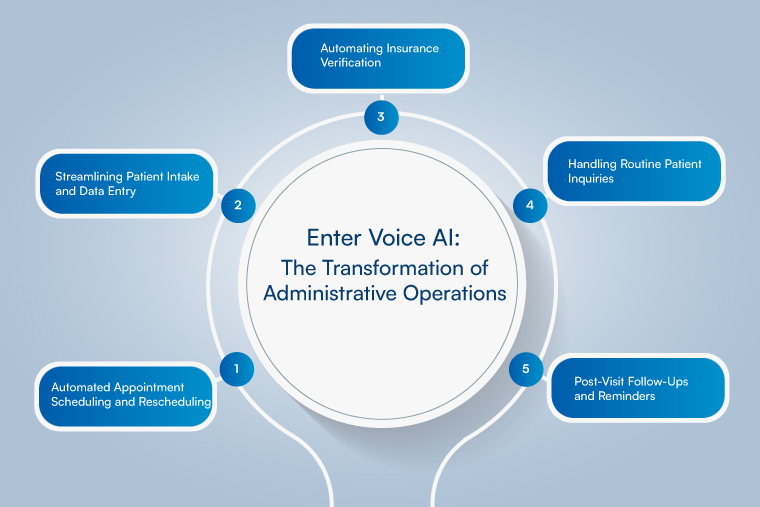
Voice AI agents are designed to change this landscape by automating routine tasks that traditionally rely on human effort. By integrating Voice AI into the healthcare workflow, hospitals can see a dramatic reduction in administrative costs while simultaneously enhancing operational efficiency and improving patient satisfaction.
Let’s take a closer look at how Voice AI solutions are driving this transformation:
1. Automated Appointment Scheduling and Rescheduling
One of the biggest drains on administrative resources in hospitals is appointment scheduling. Patients often call during business hours, wait on hold, and then go through a lengthy process to schedule or reschedule their appointments. Voice AI agents can automate this process 24/7, offering patients the ability to:
- Schedule, reschedule, or cancel appointments without the need for human intervention.
- Receive real-time updates and reminders about their appointments.
- Integrate seamlessly with the hospital’s electronic health record (EHR) system to ensure that the scheduling is updated in real time.
This reduction in manual scheduling not only saves administrative costs but also improves patient access to care by cutting down on wait times and eliminating human error in scheduling.
2. Streamlining Patient Intake and Data Entry
Patient intake especially in a busy hospital setting can be a time-consuming, error-prone process. Patients must often fill out lengthy forms, provide insurance details, and answer multiple questions before even seeing a healthcare provider.
Voice AI agents can streamline this process in several ways:
- Automated Data Collection: Patients can provide information to the Voice AI agent in a conversational format, reducing the need for manual entry and ensuring data accuracy.
- Real-Time Updates: Voice AI can automatically integrate collected data into the hospital’s patient management system (PMS) and EHR, ensuring that the information is always current and accessible.
- Improved Patient Experience: By reducing paperwork and offering an intuitive, easy-to-use intake process, patients have a more pleasant, frictionless experience from the moment they enter the hospital.
In doing so, Voice AI eliminates human error in data entry and frees up valuable staff resources to focus on more pressing patient care needs.
3. Automating Insurance Verification
Insurance verification is one of the most time-consuming tasks in the administrative workflow. Front desk staff must manually check patient insurance details, verify coverage, and often spend time following up with insurance providers. This process is not only slow but prone to errors, leading to rescheduling, billing delays, and unhappy patients.
Voice AI can streamline this process by:
- Integrating with Insurance Databases: Voice AI agents can automatically check insurance details in real-time by interfacing with the hospital’s billing system and third-party insurance databases.
- Reducing Human Error: By automating the verification, Voice AI ensures that only accurate data is captured and reduces the need for follow-ups, rescheduling, or claims denial.
- Speeding Up Processing: What traditionally took days or weeks, Voice AI can achieve in seconds, allowing hospitals to speed up the patient intake process and reduce administrative overhead.
4. Handling Routine Patient Inquiries
Patient inquiries can be high-volume and routine whether it’s asking about office hours, directions, services, or insurance details. Front desk staff often spend a large chunk of their day handling these basic inquiries, resulting in a slowdown of more critical patient care.
Voice AI agents can answer these questions instantly, without human intervention:
- Instant Access to Information: Patients can call in at any time and have their questions answered about scheduling, office policies, services, etc.
- 24/7 Availability: Voice AI is always on, ensuring that patients can access answers to their questions even outside business hours.
- Reduced Call Hold Times: By automating this process, patients no longer have to sit on hold, and staff can focus on more critical matters.
5. Post-Visit Follow-Ups and Reminders
Follow-up reminders are critical for ensuring that patients adhere to treatment plans, show up for future appointments, and receive timely care. Traditional methods of sending reminders whether through phone calls, text messages, or emails often require manual effort.
Voice AI agents can:
- Automate Follow-ups: Voice AI can handle the follow-up process by reaching out to patients for appointment reminders, medication updates, and post-treatment instructions.
- Ensure Timely Communication: Automated follow-up ensures patients don’t miss important care steps, improving patient outcomes.
- Reduce Administrative Time: By automating this task, Voice AI frees up front desk staff to focus on more complex patient concerns.
The Financial Impact of Voice AI on Hospitals
The financial benefits of Voice AI for hospitals go beyond just time savings. By automating routine administrative tasks, hospitals can experience significant cost reductions and improved operational efficiency. Here’s how:
1. Reduce Labor Costs:
Automating appointment scheduling, insurance verification, and patient intake significantly reduces the need for additional administrative staff. Voice AI agents can handle high volumes of patient inquiries and administrative tasks 24/7, ensuring that less manpower is required to manage these processes. With fewer staff needed for repetitive work, hospitals can reallocate their human resources to more complex, patient-facing tasks. This shift leads to direct cost savings by reducing the need to hire and maintain large administrative teams.
2. Increase Patient Throughput:
Faster appointment scheduling and streamlined intake processes allow hospitals to see more patients per day without compromising the quality of care. Voice AI can handle appointment bookings in seconds, cross-referencing provider availability and optimizing schedules in real-time. By accelerating these processes, hospitals can fit more patients into the day, improving patient flow while maintaining a high standard of care. This increased efficiency directly translates into a higher volume of appointments, generating more revenue without the need for additional resources or infrastructure.
3. Improve Revenue Cycle Management:
Voice AI helps minimize errors in billing and scheduling, ensuring hospitals can collect payments more efficiently and reduce denials. By automating the insurance verification process and ensuring that all patient information is accurately entered into the system, Voice AI minimizes costly mistakes that can lead to delayed payments or denied claims. With more accurate billing and timely processing, hospitals can expect faster payment cycles, improved cash flow, and reduced administrative overhead related to revenue cycle management.
4. Enhance Operational Efficiency:
By automating repetitive tasks such as patient inquiries, appointment reminders, and follow-ups, Voice AI agents help hospitals operate more efficiently. This automation reduces bottlenecks, speeds up processes, and enhances coordination across departments. With fewer manual tasks to manage, healthcare providers can focus on delivering high-quality patient care, while the backend systems run smoothly. As a result, hospitals are able to meet increasing patient demand while optimizing staff workload and improving overall financial performance.
How Much Does a Typical Voice Agent Cost Per Call?
While traditional human-led call centers are often priced by the hour or per-headcount, Voice AI shifts the financial model toward usage-based efficiency. Understanding the cost per call helps hospitals visualize the immediate ROI when compared to the overhead of a human-managed front desk.
1. Per-Minute vs. Per-Interaction Pricing
Most Voice AI providers offer two primary ways to calculate costs:
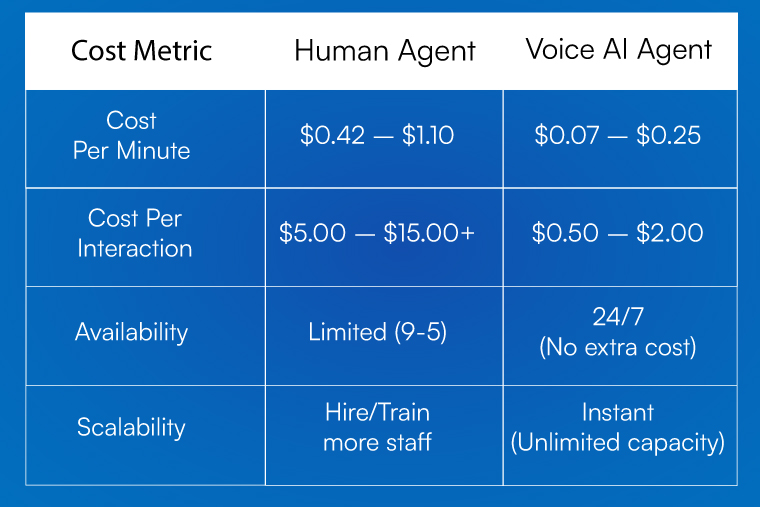
- Per-Minute Rates: In 2026, the industry standard for healthcare-grade Voice AI ranges from $0.07 to $0.25 per minute.
- Per-Interaction Rates: For hospitals that prefer a flat fee per engagement (regardless of length), costs typically land between $0.50 and $2.00 per call.
2. Cost Comparison: AI vs. Human Staff
The financial gap between automated and manual handling is significant. When factoring in salaries, benefits, training, and office space, a human-led call in the US costs exponentially more.
3. Factors Influencing the Cost
The specific price for a hospital implementation often depends on the complexity of the "intelligence" required:
- Basic Inquiries: Simple FAQ tasks (e.g., "What are your hours?") are the least expensive.
- Clinical Integration: Calls that require real-time reading/writing to an EHR (Electronic Health Record) or scheduling system may have a slight premium due to the secure API orchestration involved.
- HIPAA Compliance: Healthcare-specific agents include a "compliance layer" to ensure data encryption and PII (Personally Identifiable Information) protection, which is typically bundled into the enterprise per-minute rate.
The "Hidden" Saving: Unlike human staff, Voice AI has zero turnover costs. Hospitals currently spend an average of $10,000 to $20,000 to replace and retrain a single administrative staff member—a cost that is entirely eliminated with AI.
Conclusion: Transforming Healthcare with Voice AI Agents
In an era where healthcare organizations are constantly seeking ways to cut costs, improve patient care, and reduce administrative burden, Voice AI agents are proving to be an invaluable tool. By automating key tasks such as appointment scheduling, patient intake, insurance verification, and follow-up reminders, hospitals can reduce administrative costs, free up staff time, and ultimately improve both patient experience and financial health.
At Cabot Technology Solutions, we specialize in custom Voice AI solutions for hospitals, designed to streamline workflows, improve efficiency, and deliver better care. Our solutions seamlessly integrate with your existing hospital management systems, providing HIPAA-compliant voice interaction, 24/7 support, and improved patient engagement.
Get Started Today!
Discover how Voice AI agents can transform your hospital's operations and help you achieve significant cost savings. Request a demo with Cabot Technology Solutions and start automating your front desk today.