

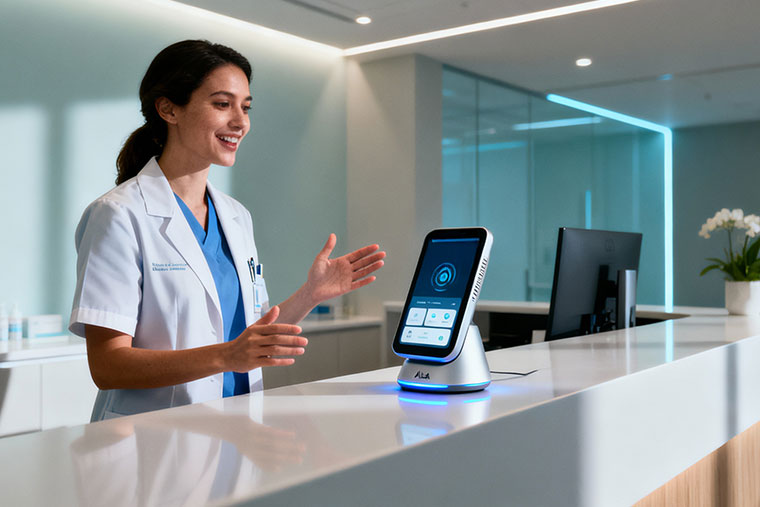
In today’s healthcare landscape, the moment a patient picks up the phone is the first real experience they have with your care. Long wait times, unanswered calls, and manual intake have become everyday stress points—both for clinics and patients. Luckily, AI voice receptionists are emerging as powerful tools that handle calls, manage scheduling, capture intake information, and reduce administrative overload—24/7 and without human fatigue.
Below, we’ve rounded up the top 7 AI voice receptionist solutions that healthcare providers should know about in 2026. These platforms vary in focus—from fully HIPAA-compliant medical receptionists to voice agent platforms that can be customized for clinics, patient access lines, and front-desk automation.
1) Cabot Technology Solutions — AI Voice Assistant for Clinics
At the forefront of healthcare-ready AI voice automation, Cabot Technology Solutions offers custom, HIPAA-aligned AI voice reception systems designed for clinics, outpatient centers, and multi-location practices. The platform focuses on real-world front desk workflows such as patient call handling, appointment scheduling, intake capture, and after-hours call management. Cabot’s solutions are built with compliance, seamless integration into existing systems, and real-time escalation logic that balances automation with human oversight.
Unlike off-the-shelf voice bots, Cabot’s AI receptionists are tailored to specific clinic workflows—reducing call backlog, improving patient access, and freeing staff to focus on higher value care tasks. The approach emphasizes practical implementation, guardrails for safety, and measurable operational improvements.
2) TriageLogic Voice AI — Healthcare Call Handling & Scheduling
TriageLogic offers voice AI solutions designed to support patient access, appointment scheduling, and inbound call routing for healthcare organizations. Its systems are commonly used to assist clinics in handling high call volumes while maintaining structured workflows and compliance expectations.
The platform is well-suited for practices that want AI-assisted call handling with strong logic around appointment flows and escalation paths.
3) Callinize Healthcare Voice AI — Automated Medical Reception
Callinize provides AI-powered voice agents that can answer patient calls, schedule appointments, and route inquiries to the appropriate departments. The platform focuses on reducing missed calls and improving patient access while integrating into existing phone systems.
Its conversational design helps clinics maintain a natural patient experience while automating repetitive front desk tasks.
4) PolyAI for Healthcare — Enterprise Voice Agents
PolyAI offers enterprise-grade conversational voice agents that can be adapted for healthcare call flows such as appointment scheduling, FAQs, and call routing. While not healthcare-only, the platform is used by organizations looking for scalable, high-quality voice interactions with natural language understanding.
Clinics with complex call volumes or centralized access lines may find this infrastructure-driven approach useful.
5) Talkdesk Healthcare Experience Cloud (Voice Automation)
Talkdesk provides healthcare-focused contact center automation, including AI-powered voice assistants for appointment booking, reminders, and patient inquiries. Its strength lies in combining voice automation with broader contact center workflows.
This option works well for clinics or healthcare networks already using contact center platforms and looking to introduce voice AI gradually.
6) Hyro Voice AI — Patient Access Automation
Hyro offers conversational AI solutions for healthcare, including voice assistants that manage patient calls, scheduling requests, and FAQs. The platform is designed to reduce call center load while maintaining a clear and compliant patient experience.
Hyro is often used by healthcare organizations seeking to automate access points without fully replacing human staff.
7) Luma Health Voice Assist — Patient Engagement & Scheduling
Luma Health provides AI-driven patient engagement tools, including voice-based scheduling and reminders. The system focuses on improving appointment adherence and reducing no-shows while simplifying front desk operations.
This solution is best suited for clinics prioritizing patient engagement and follow-ups alongside scheduling automation.
Why Clinics Need AI Voice Receptionists Now
AI voice receptionists are more than automated answering machines—they’re tools that:
- Capture more patient calls without adding staff
- Reduce hold times and call abandonment
- Automate appointment scheduling and rescheduling
- Collect structured intake data accurately
- Handle after-hours inquiries reliably
- Support multilingual access and scalability
With healthcare access pressure increasing and patient expectations shaped by consumer technology, clinics that adopt voice AI can stay ahead in both experience and efficiency.
Frequently Asked Questions (FAQs)
Q: What is an AI voice receptionist in healthcare?
An AI voice receptionist is a voice-powered artificial intelligence system that understands natural speech and manages incoming calls like a human receptionist—scheduling appointments, answering inquiries, capturing intake information, and routing complex calls to staff.
Q: Are AI voice receptionists HIPAA-compliant?
Top healthcare voice AI platforms prioritize HIPAA compliance through encrypted call data, secure access controls, audit trails, and strict data handling policies. When choosing a solution, verify vendor security practices and BAAs (Business Associate Agreements).
Q: Can these AI receptionists replace human staff?
Not completely. They are designed to augment human teams by handling repetitive, high-volume work so staff can focus on tasks that require nuance, empathy, or clinical judgment.
Q: Do AI voice receptionists work after hours?
Yes. One of the biggest benefits is 24/7 availability—capturing appointment requests, delivering scheduled reminders, and responding to basic inquiries without human intervention.
Q: How long does it take to deploy an AI voice receptionist?
Deployment times vary by solution and integration complexity, but many platforms can be implemented within weeks with proper configuration and clinic workflow alignment.
Final Thoughts
As patient expectations evolve and administrative burdens grow, AI voice receptionists are becoming essential tools for modern clinics. Whether you want a fully custom, clinic-specific solution like what Cabot Technology Solutions offers—or you’re exploring best-in-class AI receptionists from established platforms like HealOS, Smith.ai, Retell, Solium, Infinitus, or MAIRA—there’s an option for nearly every size and type of practice.
Right now, the smartest healthcare organizations are using voice AI not to replace people, but to reinforce patient access, reduce stress on staff, and ensure no call goes unanswered.