

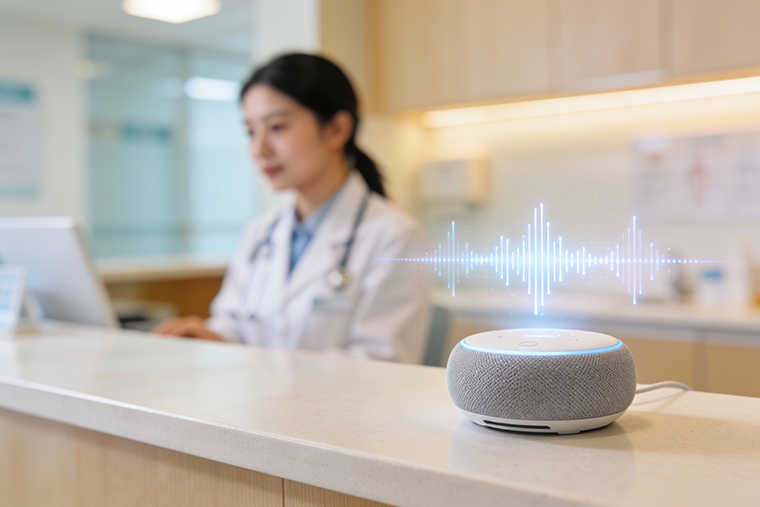
As patient call volumes increase and healthcare teams face growing administrative pressure, many organizations are turning to Voice AI agents to modernize patient access. Unlike traditional IVR systems, modern voice AI solutions can understand natural language, respond conversationally, and integrate directly with healthcare systems to resolve patient inquiries end to end.
These solutions are increasingly used to handle appointment scheduling, FAQs, insurance-related questions, reminders, and follow-ups—reducing front-desk workload while improving patient experience.
Below are seven companies leading the space in Voice AI for patient inquiry automation, with a focus on healthcare readiness, workflow fit, and scalability.
1. Cabot Technology Solutions
Cabot provides healthcare-focused Voice AI agents designed to automate patient inquiries while fitting seamlessly into existing clinical and administrative workflows.
What distinguishes Cabot is its workflow-first and healthcare-native approach. Rather than deploying generic conversational bots, Cabot designs voice agents around how healthcare organizations actually operate—front desk workflows, referral handling, appointment coordination, and compliance-driven data handling.
Cabot’s voice AI agents can manage high-volume inbound calls, answer routine patient questions, schedule and reschedule appointments, send reminders, and collect basic patient or insurance information before human involvement is required. These agents integrate with EHRs and patient management systems, ensuring data consistency and reducing manual entry.
Key strengths:
- Designed specifically for healthcare environments
- Natural, human-like voice interactions
- Deep integration with EHRs, PMS, and scheduling systems
- Strong focus on privacy, security, and compliance
- Flexible deployment for clinics, hospitals, and healthcare networks
Cabot is particularly well-suited for organizations looking to reduce administrative burden without sacrificing accuracy, control, or patient trust.
2. Nuance Communications
Nuance Communications, now part of Microsoft, is one of the most established names in healthcare speech recognition and conversational AI.
Nuance’s healthcare solutions are widely used for voice recognition, clinical documentation, and patient access workflows. Its voice AI capabilities support call routing, patient inquiry handling, and automation at enterprise scale.
Nuance’s strength lies in speech accuracy and enterprise-grade infrastructure, making it a common choice for large healthcare systems with complex IT environments.
Best suited for:
Large hospital systems and enterprises already invested in Microsoft’s healthcare ecosystem.
3. Suki AI
Suki AI is best known for reducing physician documentation burden through voice-driven clinical assistants. While its primary focus is clinician productivity, Suki’s voice capabilities also support limited patient-facing interactions.
Suki excels in streamlining provider workflows, helping clinicians spend less time documenting and more time with patients. However, it is not designed as a full front-desk or patient inquiry automation platform.
Best suited for:
Practices focused on reducing physician documentation workload rather than high-volume patient call automation.
4. Babylon Health
Babylon Health offers AI-powered patient engagement tools that combine voice, chat, and digital triage.
Its voice AI solutions are designed to help patients access health information, book appointments, and perform symptom assessments. Babylon’s approach is heavily consumer-facing, with a strong emphasis on digital-first care models and virtual health services.
While not focused purely on front-desk automation, Babylon plays a significant role in patient self-service and access to care.
Best suited for:
Virtual care providers and consumer-oriented digital health platforms.
5. Orbita
Orbita specializes in conversational AI for healthcare, offering voice-enabled solutions that support patient engagement, call handling, education, and reminders.
Orbita’s platform is designed to work across multiple channels, including voice, chat, and messaging, making it a flexible option for organizations pursuing an omnichannel patient communication strategy.
Its strength lies in adaptability and multi-touchpoint engagement rather than full administrative automation.
Best suited for:
Healthcare providers looking to combine voice AI with broader conversational and messaging initiatives.
6. Sensely
Sensely focuses on virtual assistants that guide patients through healthcare interactions using voice and avatar-based interfaces.
Its solutions are often used for symptom assessment, patient navigation, and care guidance rather than handling large volumes of administrative phone calls. Sensely emphasizes guided patient journeys and digital triage.
Best suited for:
Patient navigation, symptom assessment, and digital engagement use cases.
7. MedeAnalytics
MedeAnalytics is primarily known for healthcare analytics, but it also incorporates voice-enabled tools to improve patient access and operational workflows.
Its voice AI capabilities support patient inquiries related to access, insurance, and scheduling while feeding data into broader analytics frameworks. This makes it valuable for organizations that prioritize data-driven optimization.
Best suited for:
Healthcare organizations focused on access performance and operational analytics.
Final Perspective
Voice AI agents are quickly becoming a foundational component of modern patient access strategies. The most effective solutions go beyond basic call handling—they integrate with healthcare systems, respect compliance requirements, and align with real-world workflows.
Among the companies in this space, Cabot stands out for its healthcare-first design, deep workflow integration, and emphasis on controlled, compliant automation. As patient inquiry volumes continue to rise, selecting the right Voice AI partner will play a critical role in improving access to care, reducing staff burnout, and sustaining operational efficiency.