


Every healthcare organization talks about patient experience.
But for most patients, experience doesn’t begin with a clinician, a diagnosis, or treatment.
It begins with a phone call.
That call might be about pain, confusion, anxiety, or something as simple as “I just need to book an appointment.” And yet, for millions of patients, that first interaction is the most fragile part of the system. Long hold times. Calls that go unanswered. Voicemails that don’t get returned until the next day. Repeating the same information to three different people.
Over time, this doesn’t just frustrate patients, it erodes trust.
Behind those calls is a front desk doing its best inside a system that was never designed for today’s demand. And that’s where the conversation around AI medical receptionists truly belongs not in hype, but in reality.
The Front Desk Is the Most Overloaded Role in Healthcare
Front-desk teams are expected to be calm, accurate, empathetic, and fast every minute of the day.
They answer phones while checking patients in. They manage scheduling changes while responding to walk-ins. They repeat the same intake questions dozens of times, often while being interrupted mid-conversation by another ringing line.
None of this work is optional. And very little of it is visible to leadership until something breaks.
When front desks fall behind, the impact ripples outward:
- Patients wait longer to access care
- Appointments are missed or double-booked
- Staff burnout increases
- Clinical teams feel the downstream effects
Hiring more people helps but only up to a point. Call volumes fluctuate. After-hours demand continues. And repetitive work keeps piling up.
What front desks need is support that absorbs pressure without adding complexity.
Why Traditional Phone Systems Are No Longer Enough
Many healthcare organizations tried to solve this problem with IVRs and call menus. On paper, it sounded efficient.
In practice, patients hate them.
“Press 1 for appointments.”
“Press 2 for billing.”
“Press 3 to hear these options again.”
Patients don’t think in menus they think in needs. And when those needs don’t map neatly to a button, frustration sets in quickly.
This is where AI phone answering services for medical offices began to evolve not as smarter menus, but as conversational systems that listen, understand, and respond like a trained receptionist would.
What an AI Medical Receptionist Really Is (and Is Not)
.jpg)
An AI medical receptionist is not a robot replacing people at the front desk. It is a voice-based AI agent designed to take on the volume and repetition that overwhelm staff while respecting the boundaries of healthcare.
It answers calls immediately, regardless of time or volume. It understands natural speech. It guides patients through common requests without rushing or fatigue. And when a conversation becomes complex, sensitive, or urgent, it steps aside and brings in a human.
In other words, it does what humans shouldn’t have to do all day long so humans can do what only they can.
Appointment Scheduling Without the Chaos
Scheduling seems simple from the outside. Inside a clinic, it rarely is.
Different visit types require different durations. Providers have preferences. Certain appointments can’t be booked back-to-back. Patients often change their minds mid-call. And rescheduling one visit can affect five others.
A voice-based AI appointment scheduling assistant for healthcare handles this patiently and consistently. It doesn’t rush. It doesn’t forget rules. It doesn’t get flustered during peak hours.
Patients get clear options. Appointments are booked accurately. And staff no longer have to clean up scheduling errors later in the day.
Patient Intake That Doesn’t Drain Staff or Patients
Intake calls are repetitive, but they’re also important. Missing information leads to delays, follow-up calls, and frustration on both sides.
Voice AI can collect essential intake details calmly and consistently, ensuring information is captured once and captured correctly. More importantly, healthcare-grade systems are designed around minimum necessary data, meaning they avoid collecting anything that isn’t required.
When conversations drift into clinical territory or uncertainty arises, the AI doesn’t guess. It escalates.
That restraint is what makes the technology safe and trustworthy.
After Hours Is Where Access Often Fails

Many healthcare organizations unintentionally send a message after hours: “Call back later.”
But patients don’t stop needing answers just because the clinic is closed.
An AI receptionist for clinics ensures that patients are still acknowledged after hours. Appointment requests are captured. Messages are structured. Urgent concerns are routed appropriately.
Even when no one is physically at the desk, patients feel heard. That alone changes how they perceive the organization.
Comparison: Traditional Receptionist vs. AI Voice Receptionist
.png)
Compliance Isn’t a Feature—It’s a Responsibility
Healthcare leaders are right to be cautious about AI. Voice conversations contain sensitive information, and mishandling them carries real risk.
That’s why HIPAA-compliant voice AI isn’t about ticking boxes it’s about behavior.
How data is collected.
What is stored.
Who can access it.
How long it’s retained.
And what the system is explicitly prevented from doing.
A responsible AI medical receptionist is conservative by design. It avoids diagnosis. It avoids advice. It avoids ambiguity. It logs, audits, and escalates when necessary.
When done correctly, it becomes safer than many manual processes already in place.
What Changes When Front Desks Are Finally Supported
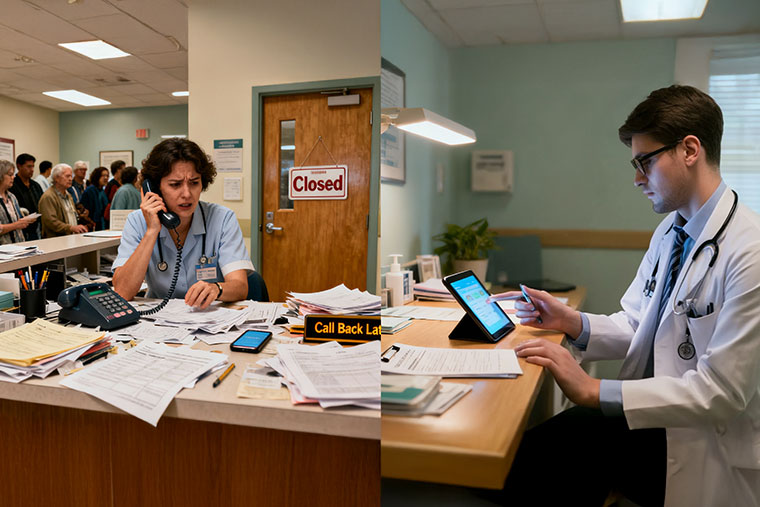
The most noticeable change isn’t technical it’s human.
Front-desk teams feel less overwhelmed. Calls feel manageable again. Patients are calmer when they reach a human because they weren’t ignored before getting there.
Over time, organizations see:
- Fewer missed calls
- Shorter wait times
- Cleaner intake data
- Lower staff burnout
- Better patient satisfaction
Most importantly, trust is rebuilt at the very first touchpoint of care.
How Cabot Technology Solutions Helps Healthcare Teams Do This Right
At Cabot Technology Solutions, we approach AI voice solutions from the ground up with healthcare realities in mind.
We work closely with healthcare organizations to understand front-desk workflows, patient access challenges, and compliance requirements before designing any solution. Our AI voice agent platforms are built to integrate smoothly, respect boundaries, and support does not disrupt existing teams.
Because in healthcare, technology should never get in the way of care.
It should quietly make space for it.
If patient access is becoming a bottleneck in your organization, the answer isn’t just more effort. Sometimes, it’s better support.
And that’s where voice AI done responsibly can make a meaningful difference.