


Introduction
Managing patient communications in a healthcare practice can be overwhelming whether it's answering patient questions, scheduling appointments, or handling administrative tasks. While traditional call centers have been a go-to solution, the rise of Voice AI is offering a smarter, more efficient way to improve patient experience and practice operations.
In this blog, we’re going to explore how Cabot's customizable Voice AI solution compares to traditional call centers, especially when it comes to handling administrative tasks in your healthcare practice. We’ll also dive into the technology behind Voice AI and how it can be tailored to your specific needs.
The Challenges of Traditional Call Centers in Healthcare

Before we dive into Voice AI, let's talk about why traditional call centers might not be the best fit for today’s fast-paced healthcare environment:
- Long Wait Times
We’ve all experienced the frustration of being placed on hold, especially when you’re already dealing with a health concern. Patients often have to wait for long periods to speak with someone, which can lead to frustration and missed opportunities.
- Human Error & Inefficiency
Human agents are great, but mistakes happen. Whether it’s miscommunication or data entry errors, a small mistake in scheduling or recording patient information can lead to bigger problems down the line.
- Limited Availability
Most call centers work during business hours, but healthcare doesn’t stop when the office closes. If patients have questions or need assistance outside regular hours, they’re often left without help, leading to missed opportunities and unhappy patients.
- High Costs
Running a call center isn’t cheap. You have to hire, train, and manage staff, all of which adds up. For smaller healthcare practices, this can quickly become an expensive overhead.
How Voice AI is Changing Healthcare Communication
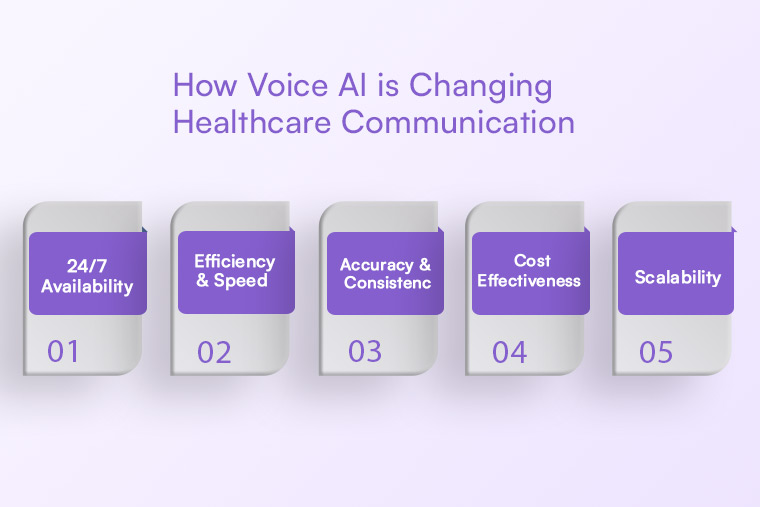
Now let’s talk about Voice AI - a technology that’s reshaping the way healthcare practices handle patient communication. Here's how Cabot’s Voice AI solution stands out:
- 24/7 Availability
Unlike traditional call centers, Voice AI is available at any time of day or night. Whether it’s scheduling an appointment, sending reminders, or answering questions, Cabot’s Voice AI is always on, giving your patients the support they need whenever they need it.
- Efficiency & Speed
Voice AI can handle multiple tasks at once. While a traditional call center can only assist a limited number of people at any given time, Voice AI can answer calls, schedule appointments, and handle administrative tasks in real-time, reducing wait times and improving overall efficiency.
- Accuracy & Consistency
One of the biggest advantages of Voice AI is its ability to handle tasks with pinpoint accuracy. It doesn’t forget patient details or make mistakes when recording important information. Everything is logged correctly, ensuring consistency across all interactions.
- Cost-Effectiveness
By automating routine tasks like appointment scheduling and patient reminders, Voice AI reduces the need for a large staff. This leads to cost savings while also freeing up your human staff to focus on more critical aspects of patient care.
- Scalability
As your practice grows, Voice AI can easily handle a higher volume of calls without you needing to hire additional staff. It’s built to scale with your practice’s needs, making it a flexible solution no matter how large or small your practice is.
Cabot’s Voice AI: The Technology Behind the Solution

Now, let’s dive a little deeper into how Cabot’s Voice AI works and what makes it so powerful for healthcare practices.
1. Natural Language Processing (NLP)
- What it is: Think of NLP as the brain that allows Voice AI to understand and respond to patient conversations in a natural, human-like way. It’s what enables the AI to process everything from simple queries to complex medical terminology.
- How it helps healthcare: With NLP, Cabot’s Voice AI understands your patients’ needs, whether they’re scheduling an appointment, asking about test results, or requesting a prescription refill. It processes those requests with the accuracy and context it needs to respond appropriately.
- Customization: You can tailor NLP to recognize specific terms unique to your practice, whether that’s medical jargon or the way your clinic describes certain services.
2. Machine Learning (ML)
- What it is: Machine learning helps Voice AI get smarter over time by learning from each interaction it has. So, the more it’s used, the better it gets at understanding patient preferences and streamlining processes.
- How it helps healthcare: This means that as Cabot’s Voice AI interacts with patients, it can adjust its responses, prioritize tasks, and improve its performance based on patterns it picks up, creating a smoother experience for both patients and healthcare providers.
- Customization: The AI can be trained to adapt to your practice specific workflows, from appointment scheduling to patient follow-ups, making it even more efficient over time.
3. Speech Recognition Technology
- What it is: Speech recognition allows the AI to convert spoken language into text and understand verbal commands, just like talking to a virtual assistant.
- How it helps healthcare: This is key for patient interactions whether it’s asking about symptoms, confirming appointment details, or simply inquiring about office hours. Cabot’s Voice AI can process speech with medical accuracy and understand different accents and speech patterns.
- Customization: The AI is flexible and can be trained to recognize specific words, phrases, and medical terminology unique to your practice.
4. Seamless Integration with Your Existing Systems
- What it is: Cabot’s Voice AI integrates with your EHR system, appointment scheduling software, and other practice management tools, so it can access patient records and update information in real-time.
- How it helps healthcare: This integration streamlines your workflow and ensures that patient data is always up-to-date. You don’t have to manually input information from phone calls; the AI takes care of that for you.
- Customization: Whether you use a specific EHR system or have unique practice management needs, Voice AI can be customized to fit seamlessly into your existing processes.
5. Smart Call Routing and Analytics
- What it is: Smart call routing ensures that each patient call is directed to the appropriate AI module or, if necessary, to a human agent. Analytics track and analyze the data to continuously improve performance.
- How it helps healthcare: This makes sure patients get the help they need right away without unnecessary transfers. And with the power of analytics, Cabot’s Voice AI can provide insights on patient behavior, common queries, and more, helping your practice make better decisions.
- Customization: You can adjust routing settings to prioritize certain types of calls or queries based on your practice needs.
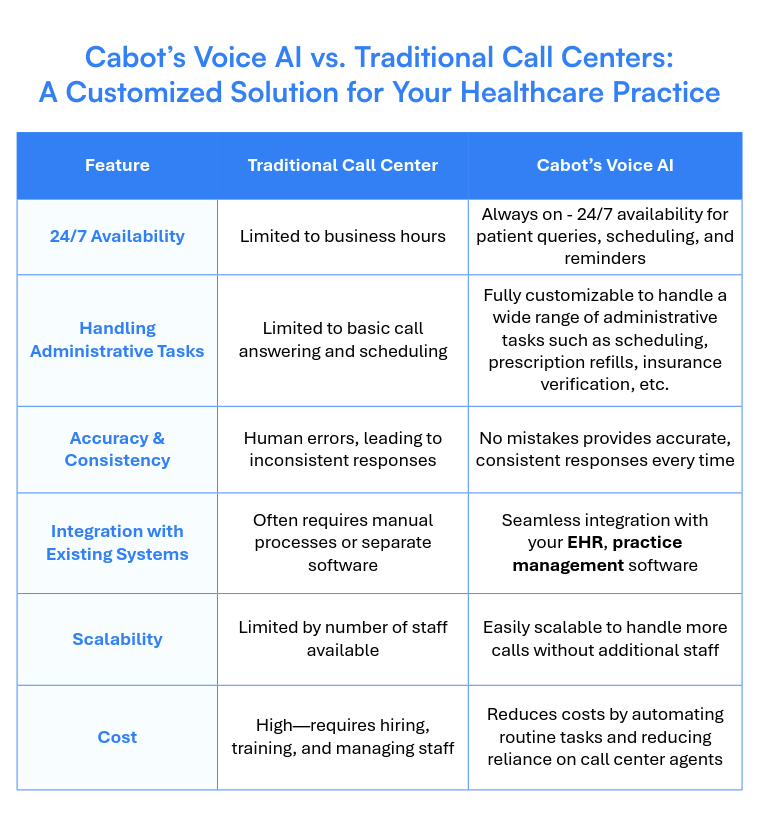
Cabot’s Voice AI vs. Traditional Call Centers: A Customized Solution for Your Healthcare Practice
To make things clearer, here’s a breakdown of how Cabot’s Voice AI compares to traditional call centers when it comes to handling administrative tasks in a healthcare setting:
Why Choose Cabot’s Voice AI for Your Healthcare Practice?
Cabot’s Voice AI is a game-changer for healthcare practices. Here’s why it’s the ideal choice:
- Customizable for Your Needs
Whether it’s handling appointment bookings or answering insurance questions, Voice AI can be tailored to fit your practice’s unique needs.
- Powered by Advanced Technology
With NLP, speech recognition, and machine learning, our solution is built to provide accurate, real-time responses and continually improve with each interaction.
- Proven Results in Healthcare
Healthcare practices using Cabot’s Voice AI have reported improved patient satisfaction, reduced wait times, and cost savings—plus, it allows your team to focus on more critical tasks.
Ready to streamline your practice’s communication and improve patient satisfaction? Contact us today to request a personalized demo of Cabot’s Voice AI and see how it can transform your healthcare practice.
Conclusion
If you're ready to streamline your healthcare practice communication and save time on administrative tasks, Cabot’s Voice AI solution can help. With advanced technology like NLP, speech recognition, and machine learning, Cabot’s Voice AI provides a seamless, accurate, and efficient way to handle patient interactions. Plus, it’s fully customizable to fit your practice needs and easily integrate with your existing systems.
Interested in learning more? Contact us today to schedule a demo of Cabot’s Voice AI and see how it can revolutionize your practice’s communication.