
Durable Robotic Process Automation Services
Most companies looking for robotic process automation services are not starting from zero. They ran a pilot, it worked, and then a vendor changed a screen layout and the bot stopped. Or the automation held but nobody owned it after go-live, so a failure sat unnoticed for a fortnight. Or the exceptions turned out to be forty percent of the volume, and the savings case quietly disappeared into a queue of humans fixing what the bot could not.
None of that is an argument against automation. It is an argument about how the work is scoped, built and maintained, and it is the part most proposals skip because it is the unglamorous part.
We build automation that survives contact with a changing business. That means choosing processes that are genuinely rule-bound, designing for the exception rather than the happy path, and naming who watches the bots on the Monday after launch. And it means telling you when robotic process automation is the wrong purchase, which is the section further down that most of this market will not write.
UiPath · Microsoft Power Automate · Automation Anywhere
No obligation, and no commitment to build. Your details stay private.
$35.27B
Current size of the global robotic process automation market, forecast to grow sevenfold over the next decade at a compound annual rate of 24.20 percent. Source: Precedence Research.
89%
Of United States operations leaders say their technology investments have not fully delivered the expected results, with integration complexity the most cited reason.
700+
Projects delivered for more than 140 clients over more than a decade, across the systems robotic process automation services have to work inside.
What robotic process automation services actually cover
Robotic process automation services are an engagement in which software robots are configured to carry out the rule-bound, high-volume steps a person currently performs across existing applications, using the same screens and interfaces a person would, without changing the underlying systems. The last clause is the whole point and the whole limitation. A bot works at the surface, which is why it can be deployed against systems you cannot modify, and also why it breaks when that surface changes. Anything that requires judgment, interpretation of an unstructured document, or a decision that a policy does not fully specify sits outside classic robotic process automation and needs either intelligent automation or an agent.
So the honest scoping question is not what could be automated. It is which parts of this process are genuinely deterministic. In our experience the answer is usually most of the volume and a minority of the cases, and the business case lives or dies on what happens to the rest. A proposal that does not name an exception rate is not a proposal, it is a brochure.
This practice sits inside Cabot's wider digital transformation work, which is where automation belongs when it is one part of a larger change rather than a standalone project.
Why automation programs stall after the pilot
The bot broke when a screen changed. An application updated, a field moved, and an automation that had run for months stopped overnight. Nothing was wrong with the build. It was built against a surface that was always going to move, and nobody planned for the day it did.
You automated the mess instead of fixing it. A process that grew by accretion over a decade got encoded exactly as it was, including the three steps that exist because of a system nobody uses any more. The waste is now faster and harder to see.
Nobody owns the bots after go-live. The build team left, the operations team was never told what to watch, and a failure sat unnoticed for a fortnight. Robotic process automation services are not a project that ends, and treating them as one is the most common way the savings evaporate.
The pilot worked and the estate never followed. One process automated beautifully and the next eleven never started, because each one needed the same discovery effort from scratch and there was no reusable pattern, no shared component library and no internal capability.
Exceptions swallowed the savings. The happy path was ninety percent of the design effort and sixty percent of the actual volume. The exception queue became a new job for a person, and the net saving was a fraction of the business case.
No audit trail when the regulator asked. The bot did the work correctly and could not prove it. Which record it touched, when, under whose authority, and on what version of the rule. In a regulated process, an unprovable action is close to an unperformed one.
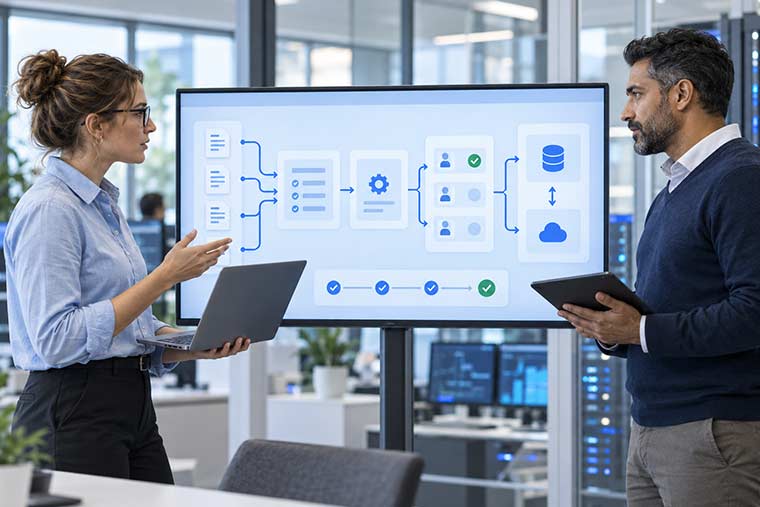
The robotic process automation services we deliver
Process discovery and assessment
Discovery is where robotic process automation services either earn their business case or lose it. We watch the work, measure the volume and the variance, and come back with a ranked list of what is worth automating, what should be fixed or retired first, and what will not repay the effort. The list that says no is the useful part.
Attended and unattended bot development
Unattended automation for scheduled, high-volume work that runs without a person. Attended automation that sits beside a user and takes the repetitive steps out of a task they still drive. Most estates need both, for different processes.
Intelligent document processing
Where the input is an invoice, a form or a scanned document rather than a clean data field, classic rules are not enough. We combine extraction models with rule-based validation so a low-confidence read goes to a person rather than into your system. The model side runs through ourgenerative AI development team.
Bot maintenance and managed automation
Monitoring, exception handling, change response and the platform upgrades nobody budgets for. This is the part of robotic process automation services that decides whether year two costs less than year one, and it is the one most vendors treat as an afterthought.
Automation platform migration
Moving an estate between platforms, usually because licensing changed or a vendor was acquired. We rebuild against the target platform rather than translating, because a translated bot inherits every assumption of the platform it left.
Center of Excellence enablement
Standards, reusable components, a pipeline for new candidate processes, and training so your team can build the next twenty without us. The goal is that you stop needing this service.
What do robotic process automation services cost?
Three things move what robotic process automation services cost: how many processes are in scope and how much they vary, the exception rate once you measure it honestly, and platform licensing, which is the cost most buyers underestimate and the one that recurs every year. We separate build cost from run cost in every estimate, because a bot that is cheap to build and expensive to keep alive is not cheap. You can model a range yourself in a few minutes, or send us one process and get a real number back against it.
Where AI fits, and where classic automation still wins
Robotic process automation services now have to answer a question buyers did not ask a few years ago, and it is worth answering plainly. AI has changed what can be automated. It has not changed what is worth automating deterministically, and conflating the two is the most expensive mistake being made in this category.
A rule bound process with high volume and a low tolerance for variation does not want a model in it. You want the same input to produce the same output every time, you want to be able to explain exactly why it did what it did, and you want the cost per transaction to be predictable. Classic robotic process automation gives you all three, and a language model gives you none of them. Putting an agent on a reconciliation that a rule handles perfectly adds cost, latency and a new failure mode in exchange for nothing.
Where AI genuinely earns its place is at the edges of the rule bound core. Reading an unstructured document before the rules can run. Classifying an inbound request so the right automation picks it up. Handling the exception queue that classic automation generates, which is exactly where the savings usually leak. That is intelligent automation, and it is a different design rather than a better version of the same one.
And where the work is genuinely judgment bound, an agent is the right answer and this page is the wrong page. That is our AI agent development practice, and the comparison below is written to route you there when it fits rather than to sell you what we happen to be describing.
The platforms we build on and where AI sits in the work
UiPath
The broadest capability set of the four, and the strongest option where an estate will grow past a handful of processes and needs orchestration, a shared component library and version control across teams.
Microsoft Power Automate
The pragmatic choice where an organization already runs Microsoft 365 and Azure, because the licensing is often already paid for and the identity and permission model is the one your security team already governs.
Automation Anywhere
Cloud native, with document processing capability built in rather than added later, which matters when a meaningful share of the input arrives as forms, invoices and scanned paper rather than clean data fields.
Blue Prism
The most governance forward of the four. Where a regulated process needs role separation, approval workflow and a defensible audit record as a property of the platform itself rather than something you build around it.
Classic RPA, intelligent automation or AI agents
Industries we automate in, and what we know about each
Healthcare and life sciences
Our deepest domain, and the one Cabot has built in longest. Eligibility verification, claims processing, prior authorization, and record transfer between systems that were never designed to exchange anything. The rules are genuinely rule bound and they change with payer policy, which makes the maintenance model matter more here than anywhere else. It runs alongside Cabot's healthcare software development practice, which carries the clinical and regulatory side.
Financial services and insurance
Reconciliation, month end close, know your customer document checks and first notice of loss intake. The volume is high and the rules are written down, which is close to ideal. What is not ideal is that the audit expectation is absolute, so the run level evidence record is part of the deliverable rather than a useful addition.
Supply chain and logistics
Order processing, carrier status updates, customs documentation and the constant reconciliation between your system and a partner's. Many counterparties, most of whose systems you do not control, which is exactly the condition surface level automation exists for and exactly why change management has to be assumed rather than hoped for.
Manufacturing and industrial
Purchase order handling, supplier onboarding, quality documentation and the reporting that sits between an ERP and a plant system that will never be replaced. The automation usually spans systems of very different ages, which is the technical difficulty rather than the process logic.
Retail and ecommerce
Order exceptions, returns processing, catalog and pricing updates, and marketplace reconciliation across channels that each report differently. Volume is seasonal rather than steady, so the design question is what happens on the worst day rather than the average one.
Shared services and back office
The horizontal case, and often the best place to start. Accounts payable, employee onboarding, IT service requests and internal reporting. The work is already centralized, already measured and already documented, which removes most of the discovery cost that makes a first automation expensive.
How bot access and audit evidence are handled
A bot needs credentials, and the first question any security reviewer asks is whose. Bots get their own identities rather than borrowing a person's, with permissions scoped to the specific systems and actions the process requires and nothing beyond. Credentials sit in a managed vault rather than inside a workflow, access is reviewed on a schedule, and a bot that no longer runs has its access revoked rather than left dormant. That last point sounds administrative and is where most automation estates carry real exposure.
On evidence, every run writes what it did, when, against which record, on which version of the rule, and what it did when it could not proceed. That record exists so an auditor can be answered without a reconstruction exercise, and so that when a bot does something unexpected you can establish what happened rather than infer it. Regulatory obligations are scoped to your market: HIPAA safeguards and a business associate agreement where healthcare data is involved, SOX-aligned controls and change approval where financial reporting is, and GDPR and CCPA behavior including deletion where consumer data is. Our compliance practice covers the wider ground. Where the process is clinical or payer facing, it runs alongside our healthcare software development practice.
How a bot actually gets built
Our robotic process automation services run to six steps, each ending in a decision you make. Step 06 is the one that makes the word durable mean something, and it is the step most proposals do not have.
Most engagements begin with a single process taken through step 01 and step 02, because the ranked list is useful to you whether or not we build anything. Send us one process and we will run it.
1. Process selection and feasibility
We measure volume, variance and rule clarity across your candidate processes and rank them. You decide what goes first, and you get the list of what we recommend not automating with the reason for each.
2. Process mapping and exception design
We map the process as performed rather than as documented, then design the exception path before the happy path. You approve what the bot does when it cannot proceed, which is the decision that sets the real saving.
3. Build
The automation is built on your platform with reusable components rather than one off logic, so the second process costs less than the first. You see the build as it happens rather than at a demo at the end.
4. Test against real variance
Tested on production representative data including the awkward cases, not a clean sample. You set the bar it has to clear before it goes near live volume. Where the testing needs depth, it runs through our QA and testing practice.
5. Controlled release
Live on a limited scope first, running alongside the existing process rather than replacing it on day one, with a rollback that has been rehearsed rather than written down. You decide when it takes full volume.
6. Monitor, maintain and retire
Someone named watches failure and exception rates, application changes are anticipated rather than discovered, and a bot whose process has changed underneath it is retired rather than patched indefinitely. You get the monitoring view, not a monthly summary.
Who works on it and what each person owns
A process analyst owns the map and the exception model, and is answerable for whether the business case survives contact with real volume. A developer owns the build and the reusable components. A test lead owns what the automation has to prove before release. And a support owner is named before go live rather than after, because an unowned bot is the failure we see most often and naming a person is the only thing that prevents it. You always know who owns a decision and you can reach them. Our depth is in four specific places. Automating across systems that cannot be modified, which is most enterprise estates. Designing exception handling that keeps the saving rather than moving the work to a queue. Building in regulated processes where the audit record is part of the deliverable. And migrating estates between platforms without inheriting the assumptions of the platform being left behind. We do not claim equal depth everywhere, and we will say when a specialist fits better. We work inside your governance rather than beside it, which means your change process, your environments and your release calendar. Where an automation program needs standing capacity rather than a project team, that runs through extending your engineering team.
Why operations leaders choose Cabot for durable robotic process automation
Bots designed to survive change
Selectors built to tolerate layout movement, exception paths designed before the happy path, and application changes anticipated on a schedule rather than discovered as an outage. This is what the word durable is doing on this page.
We tell you what not to automate
Every discovery ends with a ranked list that includes the processes we recommend fixing or retiring instead. A vendor whose assessment never says no is running a sales process rather than an assessment.
Platform neutral, including about licensing
We build on what your organization already licenses where that is the right answer, and we say plainly when it is not. Licensing is the cost buyers most often underestimate when they price robotic process automation services, and the one that recurs every year.
Security and audit built into the run
Bots hold their own scoped identities, credentials sit in a managed vault, and every run writes an audit record an auditor can read without a reconstruction exercise. In a regulated process that record is part of the deliverable.
Someone is named before go live
Maintenance ownership is agreed as part of the build rather than negotiated afterward. The most expensive automation failure we see is the one nobody was watching, and it is prevented by a name rather than a process document.
A full engineering practice behind it
Where automation turns out to be the wrong tool, the right one is in the building. Modernization, integration and applied AI each have a deeper team inside our AI engineering practice.
Where to go next, depending on what the work actually is
The work needs judgment, not rules
If the path cannot be written down in advance because each case is decided rather than processed, a bot will fail at it and an agent will not. That is our AI agent development services.
The underlying system is the problem
If you are automating around a system because changing it is too hard, the automation is a workaround with a maintenance bill attached. Consider application modernization services first.
You are automating across the whole estate
If this is one part of a broader change in how the organization operates, it should be sequenced with everything else rather than run on its own. That is digital transformation.
Our Clients














They are an engagement in which software robots are configured to perform rule bound, high volume steps across your existing applications, using the same screens a person would, without changing the underlying systems. In practice the service covers process discovery, bot development, testing against real variance, controlled release and ongoing maintenance. The last of those is what determines whether the savings hold.
Cost is driven by how many processes are in scope and how much they vary, the exception rate once measured honestly, and platform licensing, which recurs annually and is the item buyers most often underestimate. We separate build cost from run cost in every estimate, because a bot that is cheap to build and expensive to maintain is not cheap. You can model a range with our cost calculator, and we scope it properly against your processes before anything is committed.
It depends on whether the work is rule bound or judgment bound, and most estates have both. If a process follows a written rule, runs at volume and has low tolerance for variation, classic automation is the better answer: same input, same output, explainable, and a predictable cost per transaction. If the path cannot be specified in advance because each case is decided rather than processed, an agent fits and a bot will not. The honest answer for most organizations is a rule bound core with intelligence at the edges, and we would rather scope that than sell you one or the other.
Unattended automation runs on its own, usually on a schedule, against high volume work with no person in the loop. Attended automation sits beside a user and removes the repetitive steps from a task they still drive, triggered by them rather than by a timer. Unattended delivers larger savings where the work qualifies. Attended reaches processes that will never be fully rule bound, which is why most mature estates run both.
It is a question of when rather than if, which is why it is designed for. Selectors are built to tolerate layout movement rather than to depend on exact positions, monitoring alerts on failure patterns rather than waiting for someone to notice, and vendor release calendars are tracked so a known change is anticipated instead of discovered. When a break does happen, the fix is a maintenance task with a named owner rather than an incident with no owner.
Usually the one you already license, unless there is a specific reason not to. Power Automate makes sense where Microsoft 365 and Azure are already in place and the identity model is already governed. UiPath suits estates that will grow past a handful of processes and need orchestration and shared components. Automation Anywhere is strong where documents are a large share of the input. Blue Prism leads on governance where a regulated process needs role separation and a defensible audit record from the platform itself.
Someone named, agreed before go live rather than after. That can be your team, with the runbooks, monitoring and training to do it, or ours under a managed arrangement. What does not work is leaving it unassigned, which is the most common way an automation program quietly stops delivering. Maintenance is a line in the estimate rather than an assumption.
Every run writes what it did, when, against which record, under which bot identity, on which version of the rule, and what it did when it could not proceed. Bots hold their own scoped identities rather than borrowing a person's credentials, so an action is attributable. That record is produced as the work happens rather than reconstructed before a review, which is the difference between answering an auditor and preparing for one.