
SMART on FHIR App Development for Healthcare
The SMART on FHIR specification is open, but every EHR applies it in its own way. An app that passes in a sandbox can still stall in a vendor's security review, or fail on its first launch from a clinician's workspace.
Cabot delivers SMART on FHIR healthcare app development for digital health companies, health systems and payers. We design the launch, the authorization and the data access together, so the app clears review and holds up in the live workflow. Every SMART on FHIR app development project starts with the EHR you need to reach, because that choice decides the launch type, the scopes and the review path.
EHR launch · Standalone launch · Backend services
No obligation. Your details stay private.
What Is SMART on FHIR, and What Does a SMART App Actually Do?
SMART on FHIR is an HL7 standard that lets a third party app launch from inside or outside an EHR, sign in through OAuth 2.0, and read or write only the FHIR data the user has approved.
SMART stands for Substitutable Medical Applications, Reusable Technologies. The current HL7 release is SMART App Launch 2.2.0, built on FHIR R4. A SMART app registers with the EHR, asks for specific scopes, receives a short lived authorization code and exchanges it for an access token. In principle the same app can then run on any EHR that supports the standard. In practice each EHR sets its own registration steps, supported resources and review process, which is why SMART on FHIR app development is an engineering discipline and not a specification exercise.
FHIR apps take three shapes. A provider app opens inside the chart with the patient already selected. A patient app lets a person see or contribute to their own record, and sits close to our patient engagement solutions and patient onboarding software. A backend service moves data between systems with no user present. Cabot builds all three.
Why Do SMART on FHIR Projects Stall After the Prototype Works?
The EHR is not the sandbox. Sandbox data is tidy. Production charts carry missing fields, local code sets and unusual encounters that only appear after launch.
Each EHR reads the specification its own way. Registration, supported scopes and launch behavior differ between vendors, so an app built for one needs real work to run on the next.
App review is a process, not a ticket. EHR vendors and health systems run security and clinical review, and a build that ignores it loses weeks at the end.
Scopes are chosen last. Asking for more access than the workflow needs draws reviewer findings and erodes clinician trust.
Sessions fail in ways demos hide. Expired tokens, lost launch context and a second browser tab break the workflow a clinician actually follows.
Version drift arrives quietly. SMART App Launch has moved from version 1 to version 2 permissions, and servers now advertise which they support, so an app needs a plan for both.
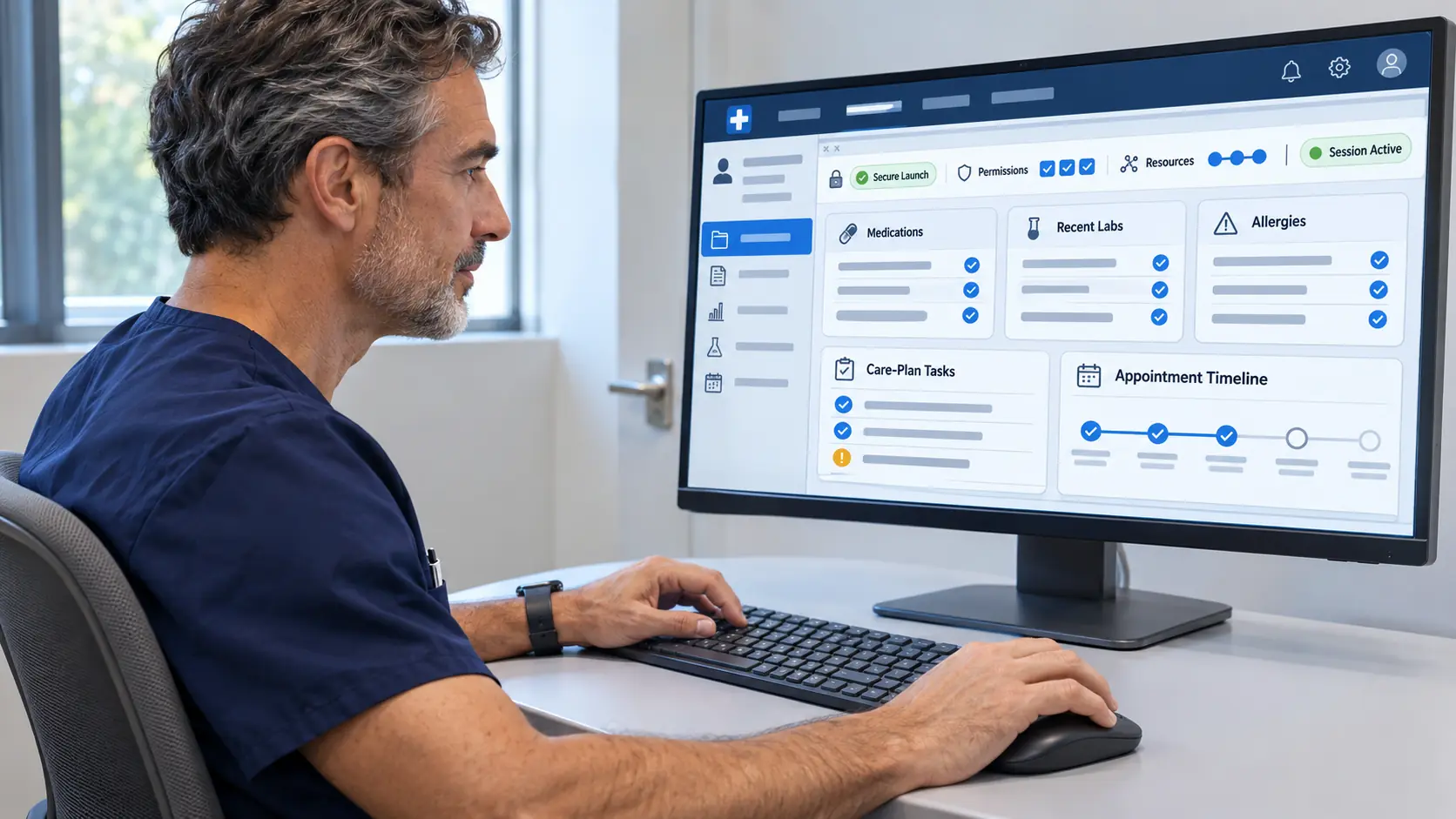
What Does a SMART on FHIR Build Cover From Launch to Listing?
Six workstreams take SMART on FHIR app development from architecture to a live EHR launch. Interface work, HL7 v2 feeds and SMART on FHIR integration beyond a single app sit with our healthcare integration services.
App architecture and clinician experience
Workflow mapping, screens designed for a few seconds of attention inside the chart, and the choice between embedded, standalone and service based delivery.
EHR launch and standalone launch
Launch URLs, patient and encounter context, and a defined fallback when context is missing.
Authorization and scopes
OAuth 2.0 with PKCE, least privilege scopes, token refresh, SMART discovery and OpenID Connect sign in where the workflow needs it.
FHIR data access and mapping
Reading and writing the FHIR R4 resources the workflow needs, mapped to US Core profiles, with handling for local variation. Wider architecture sits with our interoperability solutions.
Backend services and system access
Server to server access for scheduled and population level work, using signed credentials and not shared secrets, with reporting that builds on our health data analysis work.
Review support and listing
Security documentation, test evidence and the submission package for EHR vendor and health system review, then version updates after launch.
What Will a SMART on FHIR App Cost to Build?
SMART on FHIR app development cost follows the number of EHRs, the launch types and whether the app writes data back, far more than it follows the number of screens. Estimate a build in a few minutes, or put a specific question to an engineer.
Where Does AI Fit in a SMART on FHIR Build?
Which Stack and Tools Do We Use to Build and Test SMART Apps?
We match the stack to your environment and not to a house standard, and every stage produces something you can review. Here is both the stack and the place where a person steps in.
SMART app stack
Front end
Back end
FHIR and cloud
Where AI helps and where a person decides
How Do You Choose Among SMART on FHIR Development Companies?
Which EHRs Run SMART Apps, and How Do They Differ?
Which Buyers Does Cabot Build SMART Apps For?
Digital health companies
For you the EHR launch is the distribution channel and a failed review is a lost quarter. We build to the review from the first sprint.
Health systems
Adoption depends on how few clicks the chart allows. We build clinician tools that read from your own EHR and fit the workflow your staff already follow.
Payers and life sciences organizations
Member and patient access apps live under access rules and need a clear consent path. We design that path with the data flow, not after it.
Which Standards and Security Controls Does a SMART App Have to Meet?
Security comes first. Scopes are least privilege, tokens are short lived and refreshed through the standard flow, secrets stay out of the client, and every access to patient data is written to an audit log. Patient data never lands in application logs.
Regulatory expectations follow the market. Certified EHRs in the US must expose a standardized FHIR R4 API with SMART support, which is why an app can rely on one specification across vendors. Whether the app itself is a regulated medical device depends on what it does with the data, which our last FAQ answer covers.
How Does SMART on FHIR App Development Move From Idea to a Live EHR Launch?
The process runs in six steps, and each one ends with a decision that is yours.
1. Choose the EHR and launch type
You decide which EHRs and which launch types ship first.
2. Design the workflow and scopes
You decide the smallest set of scopes the workflow needs.
3. Build against the sandbox
You decide which FHIR resources the app reads and which it writes.
4. Test with realistic data
You decide what evidence the reviewer will see.
5. Pass review and register
You decide who owns the vendor or health system submission.
6. Launch and maintain
You decide the update cadence for EHR and specification changes.
Who Builds and Owns Your SMART on FHIR App?
The team has one accountable owner per risk. A solution architect owns launch and authorization design. A FHIR engineer owns data access and mapping. A front end engineer owns the clinician experience. A QA engineer owns test evidence. A security reviewer owns the controls. A delivery lead owns the plan and your questions.
Our SMART on FHIR developers are deepest in four areas: EHR launch and authorization design, FHIR R4 mapping with US Core, clinician facing React interfaces, and test evidence for security and clinical review.
You work with the team directly. Sprint demos run against a real sandbox, the backlog is shared, engineers join your channels, and every scope and launch decision is logged with its reason.
Why Healthcare Leaders Choose Cabot for EHR-Embedded SMART on FHIR App Development
Fast delivery
A scoped first version reaches a sandbox quickly, using the approach behind our MVP development services.
Customization
Each app fits one workflow and one EHR first, drawing on our product design and development practice.
Security and compliance
Least privilege scopes, audit logging and review evidence are part of the build, not an add on.
A FHIR application development company that stays on healthcare
Our wider healthcare software development services cover the systems around your app.
Standards beyond the app
Data exchange, terminology and interface work are handled by teams already doing it, through our healthcare integration services.
Engineering built for review
AI speeds the repeatable work and engineers own every decision.
Client Success Stories

PointClickCare Integration: Real-Time Admission Alerts for Skilled Nursing Intake
See how Cabot built a real-time PointClickCare ADT integration on Azure that sends skilled nursing admissions straight to a HIPAA-compliant intake platform.
Read the case study
AI-Accelerated Discovery to MVP for a HIPAA-Compliant Patient and Physician Marketplace
See how Cabot took a HIPAA-compliant, four-portal telehealth marketplace from discovery to a working MVP with licensure-aware booking, video, and payments.
Read the case study
Text2SQL with Streamlit
Learn how Cabot used Python and Azure OpenAI to build a Streamlit app that turns plain-English questions into SQL and delivers real-time answers for faster analysis.
Read the case study
FHIR Server & FHIR Auth Configuration for Secure API Access
See how Cabot built a FHIR-compliant server with Firely Auth (OAuth2/OpenID Connect) and MSSQL for secure, standards-based access to healthcare data.
Read the case studyWhat Should You Look at Next?
You need your systems to exchange data beyond the app
Interface feeds, HL7 v2 and system to system exchange sit beyond a single app and need their own plan. See healthcare integration services.
You need a FHIR and standards architecture across the enterprise
One app is a start, and a shared FHIR and standards design keeps every later app consistent. See interoperability solutions.
You need decision support inside the clinician's workflow
Alerts and recommendations reach the clinician at the point of care, inside the chart. See clinical decision support.
You want an AI agent that works from FHIR data
Assistants that read FHIR data run with clinician set limits and a full audit trail. See AI agents for healthcare.
Our Clients


















Most major US EHRs support SMART on FHIR, including Epic, Oracle Health, MEDITECH, athenahealth and eClinicalWorks, but each differs in launch types, available resources and review steps. Confirm the developer route with each vendor before design, because it decides the scopes, the sandbox and the approval timeline for your app.
An EHR launch starts inside the EHR and passes the patient and encounter context to the app, while a standalone launch starts outside the EHR and asks the user to authorize and select a patient. Provider apps usually need the first, patient apps often use the second, and many products support both.
The build and the EHR review run on different clocks, and the review often sets the launch date. A focused first version can be built in a short series of sprints, while vendor approval depends on the EHR, so start the registration conversation in the first week.
Cost depends mainly on the number of EHRs you target, the launch types you support and whether the app writes to the EHR, not on screen count, and writing to the EHR adds review work. Use the Cost Calculator for a first estimate, then confirm the scope in a scoping call.
No. FHIR defines the data model and the API, while SMART defines how an app launches, signs in and receives approved access to that data. A SMART on FHIR app uses both.
Not always, but servers now advertise version 1 and version 2 permission support separately, so an app must match what each target EHR supports. We review existing apps against each EHR and plan the scope changes before they become a launch blocker.
Sometimes. Write access depends on the EHR, the FHIR resource and the scopes granted, and many EHRs allow writing to a limited set of resources only. Decide early which writes the workflow truly needs, because that choice shapes both the design and the review.
It can be. An app that supports diagnosis or treatment decisions may fall under FDA oversight, while an app that only displays records usually does not. We prepare the evidence and your regulatory counsel makes the determination.