

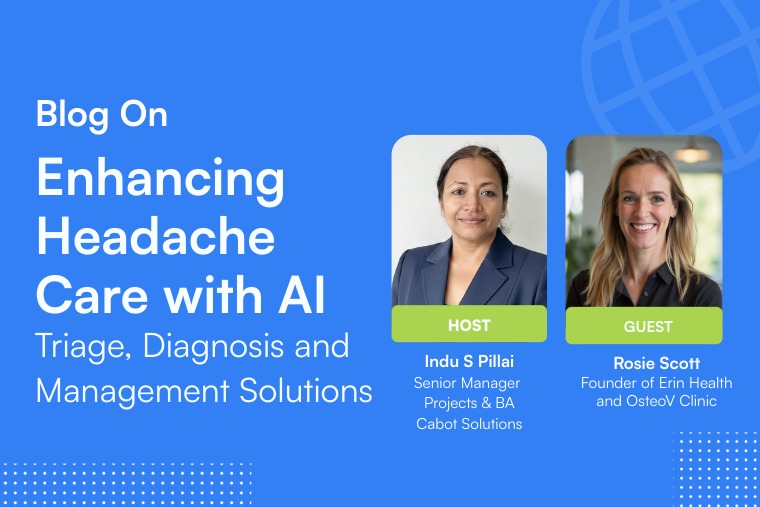
Healthcare organizations worldwide are exploring how AI can reduce operational friction, improve patient experiences, and support clinicians without replacing clinical judgment. In our recent webinar, Rosie Scott shared how her collaboration with Cabot Technology Solutions is helping shape an AI-powered triage solution focused on headache care.
The session explored the growing gaps in healthcare workflows, the challenges clinicians and patients face today, and how thoughtfully designed AI solutions can support more accurate, personalized, and accessible care delivery.
Why This Solution Was Needed
Timestamp: 01:48 – 03:33
One of the strongest themes throughout the discussion was the growing disconnect between patients and overloaded healthcare systems.
Rosie Scott explained that many patients dealing with chronic headaches often feel unheard during consultations. At the same time, clinicians and general practitioners are frequently limited by time constraints, making it difficult to capture a complete medical history during short appointments.
This creates several problems:
- Patients turn to unreliable online sources for answers
- Important symptoms or “red flags” may be missed
- Consultations become fragmented
- Clinicians spend additional time gathering incomplete information
The goal of the AI-driven triage solution is not to replace clinicians, but to help structure and streamline information gathering before the consultation begins.
By collecting detailed patient inputs early, the platform aims to support more informed clinical conversations while helping patients feel better understood.
Building AI Responsibly: Privacy, Ethics & Patient Consent
A major focus of the webinar was the importance of ethical AI implementation in healthcare.
Rosie emphasized that patient trust depends heavily on how personal information is handled. The platform was designed with regulatory compliance and privacy-first architecture in mind.
Some of the key safeguards discussed included:
- Patient-identifiable information is stored separately
- Clinical data processed by AI is anonymized
- Encrypted databases protect sensitive records
- Consent and transparency remain central to the workflow
This approach helps balance innovation with responsible healthcare data management — an increasingly important requirement as AI adoption grows across healthcare organizations.
Two Different Reports for Two Different Needs
One of the most practical features discussed during the session was the platform’s dual-report system.
Clinician Report
The clinician-facing report is designed to provide concise, medically relevant summaries that reduce cognitive overload and save consultation time.
The report may include:
- Structured symptom summaries
- Potential red flags
- Relevant medical history
- Differential diagnosis considerations
This helps clinicians quickly understand the patient’s condition before the consultation begins.
Patient Report
The patient-facing report takes a very different approach.
Instead of using highly clinical terminology, the report uses accessible and supportive language that helps patients better understand their symptoms without creating unnecessary anxiety.
The objective is to empower patients with clearer guidance while encouraging better self-advocacy during consultations.
This distinction between clinician communication and patient communication highlights an important UX principle in healthcare AI: different users require different experiences.
Reducing Healthcare Costs Through Smarter Triage
The webinar also explored the operational and financial potential of AI-assisted triage systems.
The solution follows a hybrid B2C/B2B model, creating opportunities for partnerships with healthcare providers and insurers.
Rosie Scott discussed how better triage processes may help reduce:
- Unnecessary specialist referrals
- Repetitive consultations
- Delays in care pathways
- Administrative inefficiencies
For healthcare organizations, this could lead to improved resource allocation and more efficient patient journeys.
For patients, it could mean faster access to the right level of care.
Expanding Access to Care in Remote Regions
Accessibility was another major topic discussed during the webinar.
The platform is intentionally designed to be:
- Mobile-friendly
- Partially fillable over time
- Easy to use outside traditional clinical environments
This becomes especially valuable for patients in rural or underserved regions where specialist care may not be readily available.
By enabling structured symptom collection remotely, the solution has the potential to support earlier intervention and better care coordination regardless of geographic limitations
The Future: Voice-Based Healthcare Interactions
Looking ahead, Rosie Scott shared plans for future enhancements to the platform, including voice recognition capabilities.
This feature is particularly important in headache care because prolonged screen time can worsen symptoms for some patients.
Voice-driven interactions could help create a more natural and accessible experience by allowing patients to describe symptoms conversationally instead of navigating lengthy forms.
The long-term vision is to make the platform feel less like software and more like a personalized consultation experience.
AI Should Support Clinicians — Not Replace Them
One of the most important takeaways from the discussion was the role AI should play in healthcare workflows.
Rosie Scott emphasized that AI is not intended to replace medical expertise or clinical judgment.
Instead, the technology should:
- Reduce friction in healthcare workflows
- Improve information accuracy
- Support clinician efficiency
- Help patients communicate more effectively
- Enable more personalized care experiences
When thoughtfully implemented, AI can become a practical support layer that improves both operational efficiency and patient outcomes.
Final Thoughts
The webinar highlighted an important shift happening across healthcare technology: successful AI solutions depend just as much on workflow design, patient trust, accessibility, and user experience as they do on algorithms.
The collaboration between Rosie Scott and Cabot Technology Solutions demonstrates how healthcare-focused AI platforms can be designed responsibly while addressing real clinical and operational challenges.
As healthcare systems continue evolving, solutions that prioritize usability, ethical AI practices, and patient-centered design may play a critical role in shaping the future of care delivery.