
Cabot's healthcare integration services connect your EHRs, applications, devices, and partner networks so patient data moves securely and accurately across every system that needs it — fewer silos, cleaner workflows, and information your teams can trust at the point of decision.
Lets Talk!Healthcare integration is the practice of connecting disparate clinical and administrative systems — EHRs, labs, imaging, pharmacy networks, billing platforms, and health information exchanges — so they share data securely and in a standardized format. It relies on standards such as HL7 and FHIR to ensure patient information flows between systems without manual re-entry, giving care teams a unified, real-time view of each patient.
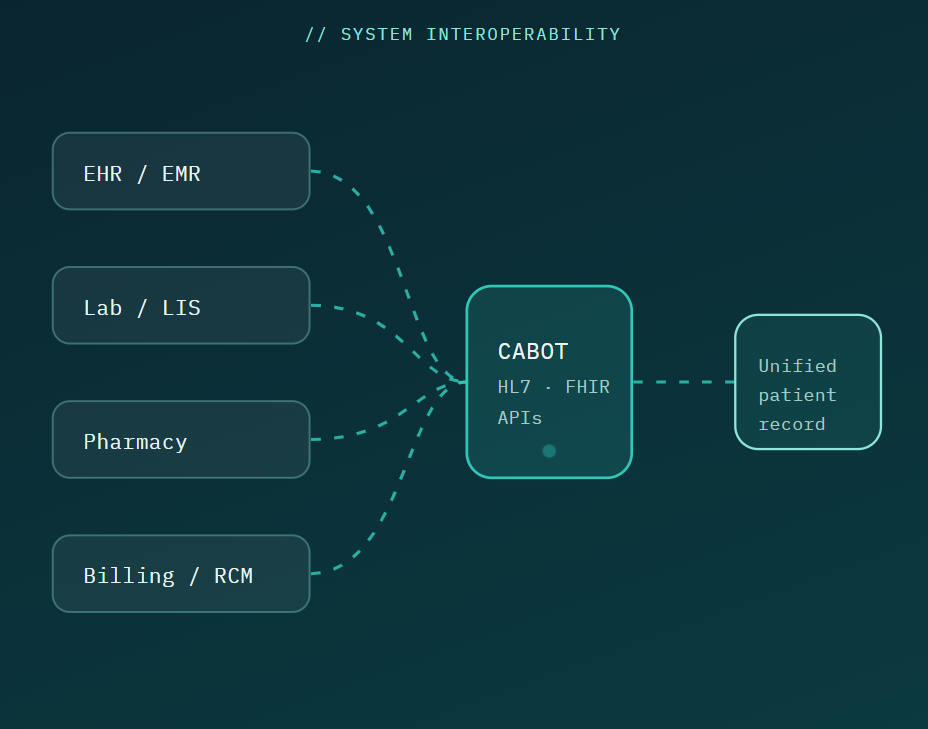
Most organizations don't run on one system — they run on dozens, each with its own format, vendor roadmap, and security model. When they don't talk to one another, the consequences land on leadership: duplicated work, delayed decisions, compliance exposure, and rising spend on workarounds that never fully solve the problem.
Can our clinicians see a complete patient record without switching screens?
Are we positioned for federal interoperability requirements?
Is our data exchange genuinely secure — or merely functional?

Connect leading EHR platforms so clinical data is shared accurately across departments and partners — one dependable view of each patient.
Interfaces built on HL7 v2, v3, and FHIR — including mapping and transformation pipelines that bridge legacy messaging with modern, API-based exchange.
Secure, scalable APIs that let your systems, partner apps, and patient-facing tools exchange data on demand, aligned to standards.
Design, build, and optimize integrations on established interface engines — reliable message routing, validation, and error handling at volume.
Move clinical and operational data between systems with integrity intact, preserving identifiers and clinical context to reduce cutover risk.
Monitoring, alerting, and ongoing support so issues are caught early and resolved fast as your systems and standards change.

Unified Epic data across departments, built to HL7 and FHIR standards.

Synchronized data across platforms to cut redundancy and streamline workflows.

Secure, real-time, nationwide data exchange via a Qualified Health Information Network.

Coordinated long-term and post-acute care through accurate, shared records.

Real-time prescription and medication history for safer medication management.

Smoother post-acute transitions and outcome insight for value-based care.
Connectivity without compliance is a liability. Every integration is engineered around recognized healthcare data standards and compliance requirements, and we follow global standards to keep your data exchange secure and interoperable.
We map your systems, data flows, workflows, and goals — identifying gaps, dependencies, and the standards each system speaks. The output is a clear roadmap scoped to your environment.
We design the integration before any code is written: data mapping, message routing, transformation logic, and the right standards and engine. Data contracts and security controls are defined up front.
Engineers build the interfaces, connectors, and APIs to spec, with validation and supportable error handling built in. Encryption, access controls, and audit logging are engineered into every layer.
Nothing touches production untested. We run message validation, end-to-end testing, and parallel validation that preserves patient identifiers and clinical context to minimize cutover risk.
We roll out in a controlled, monitored way and support your team through cutover, so clinical and operational data keeps moving without disruption to care or billing.
After go-live we monitor performance, alert on issues early, and refine as your systems and standards evolve — including version upgrades and standards updates — keeping integrations reliable long term.

Healthcare integration connects separate clinical and administrative systems — EHRs, labs, imaging, pharmacy, billing, and health information exchanges — so they share data securely in a standardized format. It uses standards like HL7 and FHIR to give care teams a unified, real-time view of patient information.
We work across HL7 v2 and v3, FHIR, and document formats such as CCD and CCDA, and we build secure FHIR and proprietary APIs for modern, app-based data exchange.
HL7 v2 is a long-established messaging standard for real-time exchange between systems. FHIR is a newer HL7 standard built on modern web technologies — REST APIs and JSON — making it faster to implement and better suited to apps, patient portals, and AI-driven tools. Many organizations run both, and we bridge between them.
We have delivered integrations across major platforms including Epic, Allscripts, and PointClickCare, along with networks such as Health Gorilla (QHIN) and SureScripts. We also build custom interfaces for other EHR, LIS, and practice-management systems.
Security is engineered into every integration — encryption in transit and at rest, role-based access controls, and audit logging — and we align delivery with HIPAA and relevant federal interoperability requirements.
TEFCA (the Trusted Exchange Framework and Common Agreement) establishes a nationwide approach to health data sharing through Qualified Health Information Networks. We design integrations with TEFCA and USCDI in mind so your organization is positioned for nationwide exchange.
Timelines depend on the number of systems, the standards involved, and project complexity. After an initial assessment, we provide a clear scope and timeline before development begins.
Yes. We offer monitoring, alerting, maintenance, and standards updates so your integrations stay reliable as your systems and regulatory requirements change.