


Introduction - The problem
A physician determines that a patient needs an MRI. The patient’s symptoms indicate that waiting could worsen their condition. The care team is ready. The imaging centre has availability. The patient wants to move forward.
Yet the procedure cannot proceed.
Not because of a clinical concern.
Not because of a scheduling issue.
But because the authorization process is still in progress.
This scenario plays out thousands of times every day across healthcare organizations. Prior authorization (PA) was originally introduced to ensure treatments and procedures were medically necessary and aligned with payer policies. While the intention was to control unnecessary healthcare spending, the reality for providers is often a process filled with manual work, fragmented communication, administrative overhead, and treatment delays.
According to industry surveys, physicians and administrative staff spend significant time each week dealing with prior authorizations. Many organizations have built entire teams dedicated solely to managing authorization requests, gathering documentation, responding to payer inquiries, and tracking approvals.
As healthcare organizations continue to face staffing shortages, growing patient volumes, and increasing administrative complexity, many are turning to AI agents to improve the process.
Unlike traditional automation tools that simply move information from one place to another, AI agents can understand context, gather information from multiple systems, execute workflows, monitor progress, and proactively take action when delays occur.
The result is a faster, more efficient authorization process that reduces administrative burden while helping patients receive care sooner.
The Hidden Cost of Prior Authorization Delays

Most discussions around prior authorization focus on administrative burden.
However, the impact extends much further.
Every delayed authorization creates a chain reaction throughout the care journey.
A patient waiting for imaging may have to postpone diagnosis.
A specialist consultation may be delayed because supporting procedures remain unapproved.
Treatment plans may need to be rescheduled.
Care teams spend additional time responding to patient inquiries and coordinating follow-up actions.
From a financial perspective, delays can also affect provider organizations through:
- Slower reimbursement cycles
- Increased administrative costs
- Higher denial management expenses
- Scheduling inefficiencies
- Lost revenue opportunities
For larger health systems handling thousands of authorizations monthly, even small inefficiencies can translate into hundreds of hours of administrative work and substantial operational costs.
This is why healthcare leaders are increasingly viewing prior authorization not simply as a payer requirement, but as a workflow optimization opportunity.
Why Traditional Automation Hasn't Fully Solved the Problem
Many healthcare organizations have already invested in workflow automation tools.
Yet prior authorization remains a major pain point.
Why?
Because traditional automation is designed to handle predictable, structured processes.
For example:
A workflow rule can automatically route a request to a specific queue.
A robotic process automation (RPA) bot can copy information from one screen to another.
A notification system can send reminders.
These tools are valuable, but they struggle when workflows become dynamic.
- Prior authorization is rarely straightforward.
- Requirements vary between payers.
- Documentation requirements change.
- Clinical records may exist in multiple formats.
- Patient circumstances differ.
- Exceptions are common.
Traditional automation often breaks down when human-like judgment is needed to navigate these variations.
AI agents address this limitation by introducing contextual understanding into the workflow.
Instead of simply executing predefined steps, AI agents can evaluate situations, gather information, determine next actions, and adapt to changing circumstances.
Understanding How AI Agents Solve The Prior Authorization Problem

The term "AI agent" is often used broadly, which can create confusion.
In the context of prior authorization, an AI agent acts as an intelligent workflow coordinator.
Think of it as a digital team member whose role is to ensure that authorization requests continue moving forward.
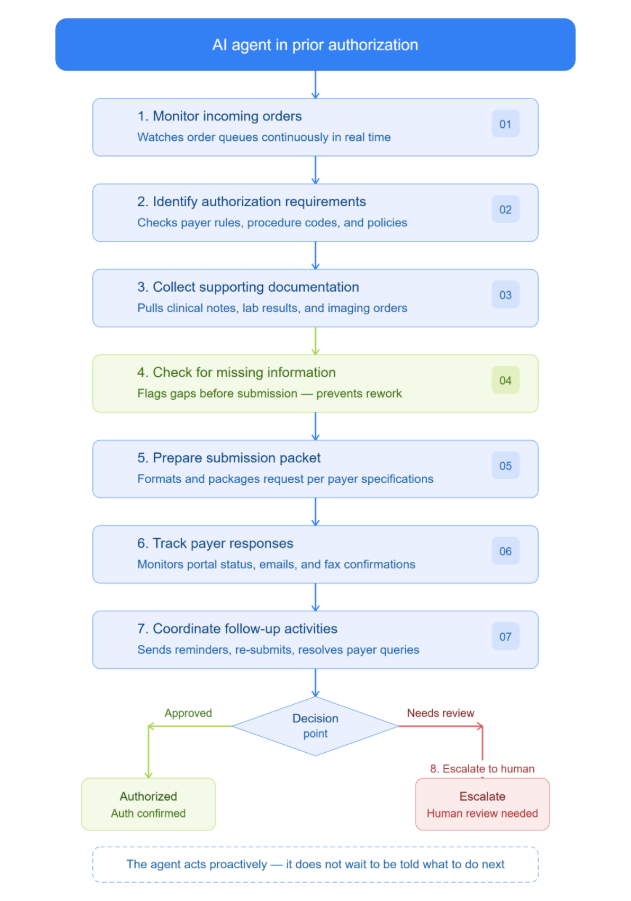
The agent can:
- Monitor incoming orders
- Identify authorization requirements
- Collect supporting documentation
- Check for missing information
- Prepare submission packets
- Track payer responses
- Coordinate follow-up activities
- Escalate issues requiring human review
Unlike traditional software, the agent does not wait for users to tell it what to do.
Instead, it actively monitors workflows and takes appropriate actions based on predefined goals and policies.
This ability to operate proactively is what makes AI agents particularly effective in reducing turnaround times.
Where Delays Actually Occur and How AI Agents Eliminate Them
Delay #1: Determining Whether Authorization Is Required
One of the first challenges authorization teams face is identifying payer requirements.
Requirements vary depending on:
- Insurance plan
- Procedure type
- Diagnosis codes
- Service location
- Network participation
Staff often spend valuable time researching payer policies before they can even begin preparing a submission.
AI Solution
AI agents can instantly evaluate patient insurance information and compare it against current payer requirements.
Instead of spending several minutes investigating each case, staff receive immediate recommendations regarding authorization needs.
This accelerates workflow initiation and reduces avoidable submission errors.
Delay #2: Collecting Clinical Evidence
Gathering documentation is frequently the longest step in the authorization process.
Staff may need to retrieve information from:
- Electronic health records
- Imaging systems
- Laboratory systems
- Referral management platforms
- Document repositories
- Scanned records
The process often resembles detective work.
Authorization specialists spend considerable time locating records, verifying relevance, and ensuring completeness.
AI Solution
AI agents can dramatically reduce this effort.
By connecting with existing systems, the agent can automatically identify relevant clinical information and assemble supporting documentation packages.
Instead of manually gathering evidence, staff review and validate information that has already been prepared.
This shifts the role from document collector to quality reviewer.
Delay #3: Missing Information
Incomplete submissions represent one of the most common causes of delays.
Missing physician notes.
Missing imaging reports.
Missing treatment histories.
Missing documentation of failed therapies.
When these gaps are discovered after submission, the authorization timeline extends significantly.
AI Solution
AI agents can perform pre-submission audits.
Before a request leaves the organization, the agent verifies that all required information is present.
This significantly reduces rework and improves first-pass approval rates.
Delay #4: Status Tracking and Follow-Up
Many authorization teams spend hours each day simply checking statuses.
They log into payer portals.
Review updates.
Search authorization numbers.
Document responses.
Repeat the process across hundreds of requests.
This work is essential but highly repetitive.
AI Solution
AI agents can continuously monitor authorization status in real time.
When updates occur, stakeholders are notified automatically.
When no progress is detected within expected timeframes, the agent can trigger follow-up workflows.
This reduces administrative overhead while ensuring requests do not become stuck in limbo.
How AI Agents Improve Communication Across Teams
One often-overlooked source of authorization delays is fragmented communication.
A physician may be unaware additional documentation is needed.
The authorization team may be waiting for a specialist note.
A scheduler may not know whether approval has been received.
These communication gaps create workflow bottlenecks.
AI Solution
AI agents help bridge these gaps by acting as a centralized coordinator.
They can:
- Notify physicians when documentation is needed
- Alert authorization teams about payer responses
- Inform schedulers when approvals are received
- Update care coordinators about status changes
By reducing communication delays, organizations can accelerate the overall authorization process.
Beyond Faster Authorizations: Improving Patient Experience
Healthcare discussions about prior authorization often focus on operational metrics.
But patients feel the consequences directly.
Patients typically do not understand why treatment is delayed.
They simply know they are waiting.
Waiting for an MRI.
Waiting for a specialist visit.
Waiting for surgery.
Waiting for medication approval.
Long authorization timelines create anxiety and uncertainty.
By reducing administrative delays, AI agents can help shorten the time between diagnosis and treatment.
For patients, that improvement often matters more than any operational efficiency metric.
What Results Are Healthcare Organizations Seeing?
While results vary depending on workflow maturity and implementation strategy, organizations adopting AI-powered authorization workflows commonly report improvements in areas such as:
- Reduced authorization turnaround times
- Faster submission preparation
- Lower administrative workload
- Improved first-pass approval rates
- Reduced denial rates
- Better visibility into authorization status
- Increased staff productivity
- Improved patient satisfaction
The greatest benefits often occur when AI is applied across the entire workflow rather than a single isolated task.
Organizations that view AI agents as workflow orchestrators rather than task automators tend to achieve the most meaningful results.
Is Your Healthcare Organization Ready for a Prior Authorization AI Agent?
AI agents can significantly improve prior authorization workflows, but successful implementation depends on more than just selecting the right technology. Before deploying a prior authorization agent, healthcare organizations need to assess their current processes, data readiness, system integrations, compliance requirements, and operational goals.
A prior authorization AI agent works best when it is implemented as part of a structured workflow strategy rather than as a standalone automation tool. The goal is not to replace human oversight, but to reduce repetitive administrative work, improve accuracy, and help authorization teams focus on exceptions, clinical validation, and payer-specific decision-making.
Prior Authorization AI Agent Readiness Checklist
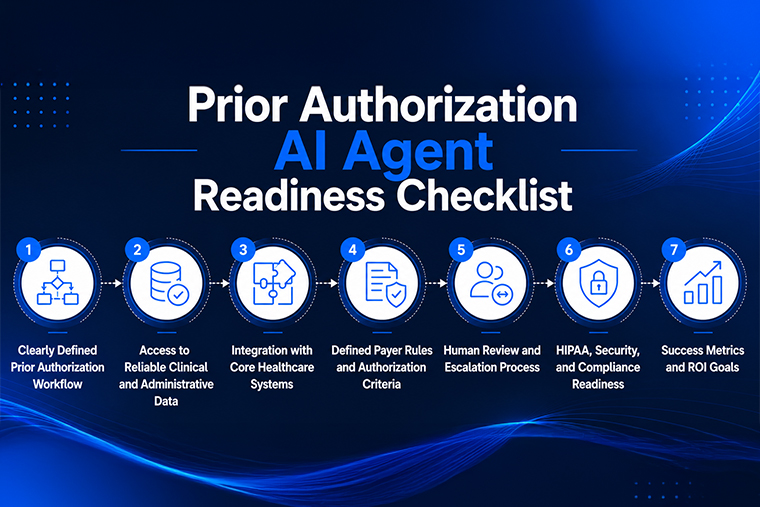
Before implementing a prior authorization AI agent, healthcare organizations should evaluate the following prerequisites:
1. Clearly Defined Prior Authorization Workflow
Organizations should have a clear understanding of how prior authorization requests currently move through the system. This includes identifying who initiates requests, where documentation is collected, how payer rules are checked, how submissions are tracked, and where delays commonly occur.
Key questions to ask:
- Which services or procedures require prior authorization most frequently?
- Where do authorization requests get delayed?
- How much time does staff spend on manual follow-up?
- What percentage of submissions are delayed due to missing information?
- Which payer portals or systems are used most often?
A clear workflow map helps determine where the AI agent can create the greatest impact.
2. Access to Reliable Clinical and Administrative Data
A prior authorization agent needs access to accurate and structured data to function effectively. This may include patient demographics, insurance details, diagnosis codes, procedure codes, provider information, clinical notes, referral details, imaging reports, lab results, and payer-specific documentation requirements.
The better the data quality, the more effectively the agent can identify missing information, prepare submission packets, and reduce rework.
3. Integration with Core Healthcare Systems
For an AI agent to support prior authorization at scale, it should connect with the systems already used by the organization. These may include:
- EHR or EMR systems
- Practice management systems
- Referral management platforms
- Scheduling systems
- Document management systems
- Payer portals
- CRM or patient communication tools
- Revenue cycle management platforms
Without integration, the agent may still help with individual tasks, but the full value comes when it can work across systems and coordinate the end-to-end workflow.
4. Defined Payer Rules and Authorization Criteria
Prior authorization requirements vary across payers, plans, procedures, diagnoses, and service locations. Organizations should have a process for maintaining payer rules and documentation requirements.
An AI agent can help interpret and apply payer requirements, but it needs access to updated rules, eligibility data, and organization-approved decision pathways.
5. Human Review and Escalation Process
Healthcare AI agents should operate with appropriate human oversight. Not every authorization request should be fully automated. Complex cases, clinical exceptions, payer disputes, and incomplete documentation should be routed to the right staff member for review.
Organizations should define:
- Which tasks the agent can complete independently
- Which tasks require staff validation
- When a case should be escalated
- Who approves submission packets before they are sent
- How clinical judgment is protected in the workflow
This ensures the AI agent supports staff rather than creating compliance or clinical risk.
6. HIPAA, Security, and Compliance Readiness
Because prior authorization workflows involve protected health information, healthcare organizations must ensure that any AI agent implementation follows strict security and compliance standards.
Important requirements include:
- HIPAA-compliant architecture
- Role-based access controls
- Audit logs
- Secure data transmission
- Data encryption
- Business Associate Agreements where required
- Clear policies for data usage and retention
- Human oversight for sensitive decisions
Compliance should be built into the implementation from the beginning, not added later.
7. Success Metrics and ROI Goals
Before implementation, organizations should define what success looks like. This helps measure the value of the AI agent and justify continued investment.
Useful metrics may include:
- Reduction in prior authorization turnaround time
- Reduction in manual staff hours
- Increase in first-pass approval rates
- Reduction in missing documentation
- Reduction in denial rates
- Faster scheduling after approval
- Improved staff productivity
- Improved patient satisfaction
- Reduction in authorization-related revenue delays
Clear baseline metrics make it easier to measure the operational and financial impact after deployment.
What Costs Are Involved in Implementing a Prior Authorization AI Agent?
The cost of implementing a prior authorization AI agent depends on the complexity of the workflow, the number of systems involved, the level of automation required, and the organization’s compliance and integration needs.
Common cost components include:
1. Discovery and Workflow Assessment
This includes reviewing the current prior authorization process, identifying bottlenecks, mapping system dependencies, and defining automation opportunities. This phase helps determine the scope of the AI agent and prevents unnecessary development.
2. AI Agent Design and Development
This includes designing the agent’s workflow logic, decision pathways, user interface, task automation, exception handling, notification flows, and reporting capabilities. More advanced agents that handle multiple payer rules, clinical document review, and status tracking will require more development effort.
3. System Integration Costs
Integration is often one of the most important cost factors. Connecting the AI agent with EHRs, payer portals, scheduling tools, document repositories, and revenue cycle platforms can vary in complexity depending on API availability, data structure, and vendor limitations.
4. Data Preparation and Rule Configuration
The agent may need payer rules, procedure-specific requirements, documentation checklists, and historical workflow data to operate effectively. Preparing and structuring this information can be a separate implementation effort.
5. Compliance, Security, and Testing
Healthcare AI implementations require strong security review, HIPAA alignment, access control setup, audit logging, and testing. This ensures the system is safe, reliable, and compliant before it is used in live workflows.
6. Training and Change Management
Staff need to understand how the agent works, when to trust its recommendations, how to review flagged cases, and how to handle escalations. Training and adoption support are essential for long-term success.
7. Ongoing Maintenance and Optimization
After deployment, the agent needs monitoring, updates, payer rule changes, workflow improvements, performance reviews, and technical support. AI agent implementation should be viewed as an evolving system, not a one-time setup.
Typical Cost Range
While costs vary by organization, a prior authorization AI agent can generally fall into three implementation levels:
Basic AI-assisted workflow: Suitable for smaller teams that want help with documentation checklists, task reminders, status visibility, and staff support.
Mid-level integrated AI agent: Suitable for organizations that need integration with EHR, scheduling, document systems, and payer workflows, along with automated status tracking and pre-submission checks.
Advanced enterprise AI agent: Suitable for larger healthcare organizations that need multi-payer rule handling, deeper system integrations, advanced analytics, escalation workflows, compliance controls, and workflow orchestration across departments.
For many healthcare organizations, the return on investment comes from reducing manual staff hours, lowering rework, improving first-pass approvals, accelerating care scheduling, and reducing revenue delays caused by authorization bottlenecks.
The most effective approach is to start with a focused use case, measure results, and then expand the AI agent across additional authorization workflows, payer categories, and administrative processes.
The Future of Prior Authorization Is Proactive, Not Reactive
Today, many authorization teams operate reactively.
They respond to missing information.
They react to payer requests.
They react to delays.
They react to denials.
AI agents enable a different model.
A proactive model.
Instead of waiting for problems to emerge, agents continuously monitor workflows, identify risks, gather information, and initiate actions before delays occur.
This shift from reactive administration to proactive workflow management may ultimately become one of the most important operational changes healthcare organizations experience over the next decade.
Conclusion
Prior authorization is unlikely to disappear anytime soon, but the way healthcare organizations manage it is rapidly evolving. AI agents offer a practical approach to reducing one of healthcare's most persistent administrative challenges by helping organizations gather information faster, prepare cleaner submissions, monitor requests continuously, and respond proactively to payer requirements.
The real value isn't simply faster approvals. It's creating a more connected, efficient, and patient-centered authorization process that reduces administrative burden, minimizes delays, and allows care teams to focus more on delivering care rather than managing paperwork.
As an AI agent development company focused on healthcare, Cabot Technology Solutions helps providers, health systems, and healthcare organizations build intelligent AI agents that automate operational workflows across prior authorization, patient intake, referral management, scheduling, care coordination, and other administrative processes. By taking repetitive, time-consuming tasks off the shoulders of clinical and administrative teams, AI agents help reduce operational overhead, improve workflow efficiency, and free up valuable staff time that can be redirected toward patient care and higher-value activities.