
AI-Native Mobile App Development Services
Most mobile projects do not fail in the app store. They fail earlier and more quietly. The budget was set before anyone decided between native and cross-platform, so the decision was made by default. Security was a checklist at the end instead of a design input at the start. And the plan stopped at launch, as if the day the app ships were the day the work ends rather than the day it begins.
Cabot provides mobile app development services that treat those three decisions as the actual project: which platform approach your product deserves, how the app will pass a security review, and who owns it after launch. We build custom mobile app development work for iOS, Android, and cross-platform products, with cloud backends included rather than assumed to exist.
AI-native describes how we deliver mobile app development services, not a sticker on the proposal. What that changes, and what it deliberately does not, is set out further down this page rather than asserted here.
iOS · Android · Flutter · React Native · Enterprise · Cloud backends | Both buttons take you further down the page. No form required to look around.
No obligation. Your details stay private.
What do mobile app development services actually include?
Mobile app development services cover the full life of a mobile product: strategy and platform selection, UX design, engineering for iOS, Android, or both from one codebase, the backend and APIs the app depends on, testing, app store submission, and the ongoing releases that keep it alive. The list matters because the phrase is used loosely. Plenty of vendors sell the middle of it, the build, and leave the two ends with you: the platform decision at the start, where most of the cost is committed, and the operating work at the end, where most of the life of the product actually happens. Mobile application development is not one project with a finish line. It is a product commitment with two operating systems moving underneath it every year, and a mobile app development services partner should be scoped, and priced, against that whole span. Where the product is a browser-based companion rather than a store-delivered app, that work sits with our web application development practice, and the honest recommendation is sometimes that you need that instead.
Why mobile projects run over, and what the overrun is made of
The budget was set before the platform. Native and cross-platform can differ by a large fraction of total cost. An estimate produced before that decision is a guess wearing a spreadsheet, and the number everyone remembers is the first one.
The test matrix was whatever the team carried. Devices were chosen by what sat on desks, not by what customers actually hold. The crash reports arrive from an OS version and a screen size nobody tested, weeks after the release everyone signed off.
Security arrived at the end. Encryption, session handling, and what the app stores on a personal device are architecture. Found at the end by a reviewer, they reopen work that was already signed off.
The app shipped and stood still. Operating systems move every year and devices change with them. An app with no owner ages in public, one store review at a time.
The vendor kept the knowledge. Code arrived without the context, the infrastructure, or the handover to run it, and the relationship became a dependency rather than a choice.
The backend was an afterthought. The app was quoted, the APIs it needs were not, and the second invoice was the surprise. A mobile product is a system, not a screen.
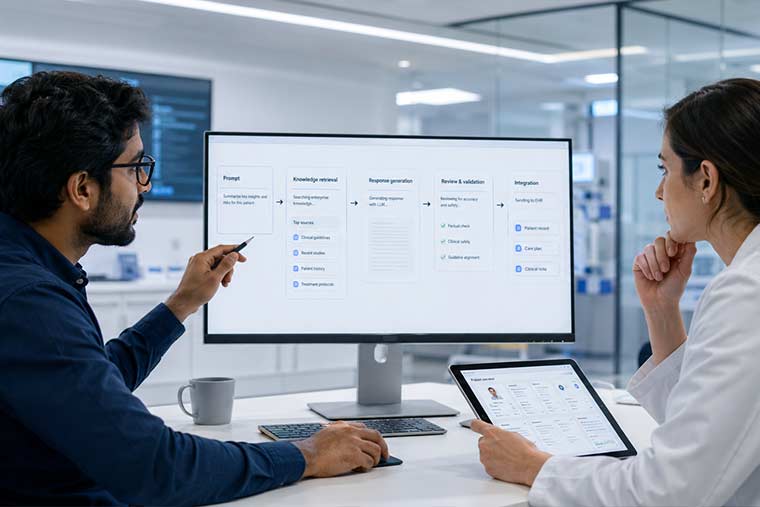
Mobile app development services for every platform decision
Custom mobile app development
Product builds shaped to your requirement rather than configured from a template, from a first consumer release to a revenue product at scale. Strategy, design, and engineering under one accountable team.
iOS app development
Native iPhone and iPad applications in Swift, built to Apple's interface conventions and review guidelines, with the release discipline App Store submission actually requires.
Android app development
Native Android applications in Kotlin, engineered for the device and OS version spread that makes Android its own discipline rather than a port of the iOS build.
Cross-platform development
One codebase for both stores with Flutter or React Native, chosen when it genuinely fits the product. Our Flutter app development practice covers that framework in depth.
Enterprise mobile app development
Workforce and B2B applications that live inside an estate: single sign-on, device management, offline-first data, and integration with the systems your teams already run.
App modernization, backend, and support
Aging apps rebuilt or migrated, the cloud backends and APIs behind them engineered properly, and releases, monitoring, and QA and testing owned after launch.
What do mobile app development services cost?
The features are the predictable part of the estimate. What moves the number is the platform approach, the backend the app needs behind it, and how long the product must be supported. We price all three before the build rather than letting them arrive as change requests.
How we assess an app you already have before proposing anything
Read the code before quoting the rebuild
An assessment covers the codebase, the release pipeline, the crash history, and what the store reviews actually say. A quote produced without those is a quote for a project nobody has looked at.
Separate what is aging from what is failing
An old codebase is not automatically a broken one. We report which parts still earn their keep, which are holding the product back, and which are simply unfamiliar to whoever inherited them.
Cost the migration against the cost of standing still
Moving to Flutter or React Native has a price, and so does another two years of maintaining two native codebases. Both are put in front of you as numbers rather than one being presented as inevitable.
Give you a plan you could hand to someone else
The assessment output is a scoped plan with reasoning, sequencing, and risks, written so it holds up if you take it to another vendor. That is the test of whether it was an assessment or a pitch.
The stack behind the apps we ship
What we build with
Native platforms
Cross-platform and frontend
Backend, cloud, and data
What does AI-native actually change in a mobile build?
Where AI sits at each stage, and where it does not
The four questions worth asking any mobile development partner, including us
Built for the way your product is judged
Healthcare organizations
We know a patient-facing app is judged by a compliance function before a user ever sees it, that device data and EHR connectivity are the real scope, and that HIPAA safeguards are architecture rather than paperwork. This work sits inside our healthcare software development practice
SaaS and startup teams
We know a first release is an argument for the next round, not a finished product, and that the platform decision made this quarter sets the burn rate for the next six. We scope for the product you can afford to still be running in two years.
Enterprise and regulated businesses
We know a workforce app lives or dies on single sign-on, device management, and offline behavior in the field, and that the audit will ask where the data sat and who touched it. The estate comes first, the app fits into it.
Industries we already understand
Healthcare
Ecommerce
Fintech
Travel and Tourism
Built to pass review from security teams, app stores, and auditors
A mobile app is reviewed by people with the authority to stop it: your security function, two app stores, and in regulated markets an auditor. We build the controls into the work rather than bolting them on afterward, so what we deliver can face those reviews without another round of rework. That means encryption in transit and at rest, secure session and credential handling on the device, role-based access on the APIs behind the app, and audit logging designed in from the first sprint.
Regulatory obligations are scoped by your market rather than applied as a blanket. For healthcare that is HIPAA safeguards and a business associate agreement. For products handling consumer data it is GDPR and CCPA behavior, deletion included. For enterprise buyers it is evidence a SOC 2 aligned process can point to. We build to the review you will actually face.
How we get you from an idea to an app people keep
Our mobile app development services follow a structured path from concept to production, with a decision point at every step and something you can judge at the end of each.
Discovery and platform decision
We establish what the product must do, for whom, on which devices, and make the native versus cross-platform decision on paper, with reasoning, before anything is designed.
Architecture and prototype
The system is designed end to end, backend included, and a tappable prototype puts the core flow in your hands before the build is funded.
Build in increments
Features land in reviewable slices on both platforms, each one shippable, so the product is testable in your hands from the first increment rather than at the end.
Test and harden
Functional, security, and performance testing across the real device matrix, with the fixes made while the team that wrote the code is still in the room.
Launch and store submission
App Store and Play submission handled as the discipline it is, review findings answered, and a rollout plan that starts small on purpose.
Operate and improve
Crash and usage monitoring, OS-update work, and a release rhythm that keeps the app current, with what real usage reveals feeding the roadmap.
The team that owns the whole product, not just the app
Mobile projects go wrong when the app team and the backend team are separate organizations with a handover between them. On our engagements that handover does not exist. A product engineer owns what the app should do and why. Platform leads own iOS and Android, including the differences that make Android its own discipline. A backend engineer owns the APIs and the cloud infrastructure. A QA lead owns the device matrix and has the authority to hold a release that is not ready.
Our depth is uneven, and it is worth knowing where. We are strongest at the platform decision, at cross-platform migration, at regulated mobile with healthcare first among those, and at the systems behind the app. We are a smaller team than the largest firms in this market. Where a product needs something outside those four areas, we say so at the scoping call rather than at the retrospective.
Why product and engineering leaders choose Cabot for AI-native mobile app development services
The platform decision is made honestly
Native, Flutter, or React Native is chosen against your product's requirements, in writing, before the estimate exists. Both paths are costed to build and to run for two years, because the gap between them is the actual decision. We carry native and cross-platform practices side by side, so there is no staffing position for the recommendation to protect.
AI speed on contractual terms
Three commitments travel with every engagement: we stay model-neutral and pick tooling per task, nothing merges without a named engineer approving it, and your code and data are never used to train third-party models. They sit in the contract, not the sales deck.
You own everything from the first commit
Code, infrastructure definitions, store accounts, and documentation are yours throughout, not handed over at the end. Leaving us is easy, which is the point.
You see the work weekly, not at milestones
Repositories, test results, and the release pipeline are open to you from the first sprint. Progress is something you check rather than something you are told about at a review.
Compliance evidence produced as we go
In regulated markets the artifacts an auditor asks for are generated while the work happens rather than reconstructed before the audit. Our healthcare software development practice runs to the same rule.
A full engineering practice behind it
Cloud, data, modernization, and applied AI each have a deeper practice within Cabot's digital transformation work, so the product does not stop at the edge of one specialty.
Where to go next, depending on what is in your way
You have an idea that needs proving first
If the business case is not settled yet, prove it small and fast. Start here: MVP development services
Your existing app is holding the roadmap back
If the constraint is an app or estate that cannot be safely changed, start with the assessment above, or with application modernization services or with the assessment described above.
You want AI working inside the app
If the product needs assistants, agents, or automation in the user's hands, that is our practice in AI agent development services
Our Clients




Strategy and platform selection, UX design, engineering for iOS, Android, or both from a single codebase, the backend and APIs behind the app, testing across real devices, store submission, and the releases that follow. When you compare vendors, the useful question is which of those sit inside the fixed price and which become change requests later.
Mobile app development services are priced by decisions more than by feature lists. Three move the number most: whether the product needs native builds or one cross-platform codebase, how much backend has to exist behind the app, and how long it must be supported after launch. A focused single-purpose app and a two-platform product with accounts, payments, and a custom backend differ by multiples. For an early figure shaped to your case, try our Cost Calculator
A focused first release typically reaches the stores inside one to two quarters. What extends timelines is rarely the app itself. An unscoped backend, a late platform change, or store review findings nobody designed for are what stretch a schedule, and all three are avoidable, which is what the discovery step is for.
Cross-platform with Flutter or React Native fits most business, commerce, and content products, and roughly halves ongoing release effort. Native earns its cost when the product leans hard on the platform: deep hardware access, demanding graphics, or platform-specific experiences. The recommendation is made in writing during discovery, with the reasoning attached.
Yes. The first step is an assessment of the current codebase, because the right move is sometimes a migration, sometimes a rebuild of specific layers, and occasionally keeping native where it is genuinely earning its cost. You get a scoped plan, with the cost of moving set against the cost of staying, before any code moves.
AI drafts features for both platforms, derives test cases from acceptance criteria, proposes migration code, and watches crash and review data in operation. It does not choose the platform, design the interaction, or decide what the app may store on a device. The governance rules that bound it are set out in the AI section above.
Obligations are scoped by your market rather than applied as a blanket: HIPAA safeguards and a business associate agreement for healthcare, GDPR and CCPA behavior including deletion for consumer data, SOC 2 aligned process evidence for enterprise buyers, and OWASP MASVS as the baseline everywhere. What each of those requires in the architecture is set out in the standards section above.
Three. A scoped build delivers a defined product on a defined budget, and suits a clear requirement. A product team gives you a stable Cabot team owning the roadmap month to month, and suits a living product. An extended team places our engineers inside your structure, and suits a client with engineering leadership who needs depth.