
Measured LLMOps Consulting Services
The demo went well. The system shipped. Then a model provider changed something on a Tuesday, a document was quietly updated, and someone edited a prompt to fix an unrelated complaint. None of it raised an error. Quality moved anyway, and the first person to notice was a customer. Meanwhile the token bill arrived and nobody could explain it.
That is the gap between building an LLM system and running one, and it is where Cabot provides both. You consulting services. We start by measuring what you actually have, agree a pass mark and a cost ceiling with you in writing, then build the evaluation, tracing, and release controls that hold the system to both.You get numbers you can report upward and a record of every answer the system has ever given.
Evaluation · Observability · Regression testing · Cost engineering · Incident response | Model-neutral and security led
No obligation. Your details stay private.
50%
Of generative AI deployments will carry large language model observability by 2028, up from 15% today, as explainable AI becomes a condition of deployment
40%
Of organizations deploying AI will use AI observability to monitor model performance by 2028
700+ projects
Delivered for 140+ clients since 2010, across the systems these models have to run inside
What is LLMOps, and how is it different from MLOps?
LLMOps is the practice of running a large language model system in production: measuring whether it is still good, watching what it costs, controlling what changes, and being able to explain any answer it gave. It is often described as MLOps for language models, which undersells the difference. MLOps assumes you own the model and retrain it on a schedule, so the thing that drifts is the data. In an LLM system you usually do not own the model, four independent things can change the output, and there is rarely one correct answer to test against. That last point is the hard one: a passing test is a judged score against an agreed bar, not a string comparison. If you are still deciding how to build the system in the first place, that decision belongs to our LLM development services rather than here.
Why LLM systems degrade quietly after launch
Quality moved and nothing failed. No error was raised, no alert fired, and the first report came from a customer weeks after the change that caused it.
The bill cannot be forecast. Token spend does not behave like a server bill, and finance is asking for a number nobody in the room can produce.
A bad answer cannot be reproduced. Nobody recorded which prompt version, which model version, and which context produced it, so the investigation stops at a screenshot.
There is no regression suite. Every prompt edit is a gamble, so changes slow to a crawl and the team stops improving the system at all.
Lock-in surfaced late. A price change or a deprecation notice arrived, and swapping the model turned out to be a re-engineering project rather than a config change.
Compliance asked and nobody could answer. Who approved this output, on what basis, and can you show me. The honest reply was that the logs do not go back that far.
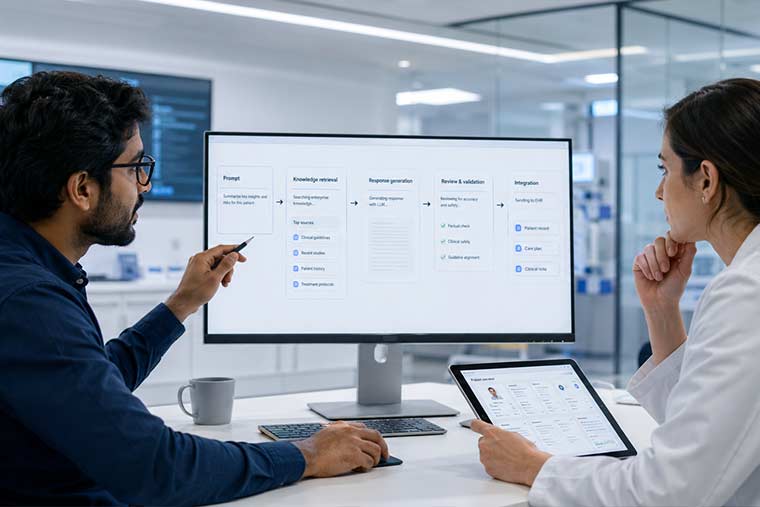
What we build to keep a system honest
Evaluation and regression suites
We build the judged question set that defines good, agree the pass mark with you, and run it against every prompt and model change before it reaches users.
Observability and drift detection
We trace every request end to end and alert on quality, latency, and cost moving, so degradation is found by a dashboard rather than by a complaint.
Cost engineering and routing
We profile spend per request, then use model routing, caching, and context trimming to bring it down, and we show you the quality cost of each change.
Prompt, model, and config versioning
We put the four things that can change under version control, so any answer can be traced back to the exact combination that produced it.
Guardrails and output validation
We validate what the system returns before a user sees it, and where answers must be grounded in your content we build that with our RAG development services.
Incident response and on-call
We define what an incident is for a system that fails silently, build the alerting and rollback around it, and hand the runbook to your team.
What do LLMOps consulting services cost to run and to keep running?
Engagement cost tracks with how much of this already exists and how many systems are in scope. The part most vendors leave out is that this work frequently pays for itself out of the token bill, because routing and caching decisions are usually the largest single saving available. We scope both numbers up front, and when the savings will not cover the work we say so rather than letting you find out later.
How we turn reliability into a number you can report
Start with a baseline, not a plan
Before proposing anything we score your live system against a question set drawn from real usage. The number is usually lower than the team expects, and it is the only honest starting point for deciding what is worth fixing.
Judge quality, do not assert it
There is rarely one correct answer, so tests are judged against agreed criteria and reported as a score. You approve the pass mark, and a release that does not clear it does not ship.
Separate the four things that can change
Prompt, model version, retrieved context, and tool definitions all move independently and all change the output. Versioning them separately is what turns an unreproducible complaint into a specific fix.
Price the fix against the token bill
Every optimization is presented as a saving and a quality cost, in the same sentence. Some are obviously worth taking. Some are not, and we will tell you which is which.
The stack behind the systems we operate
Target stack
Evaluation and testing
Observability and tracing
Serving and deployment
What happens at each stage
How we choose and govern the tooling
Where LLMOps stops behaving like the operations you know
Built for the way your industry is judged
Healthcare
We know a clinical reviewer will ask which version of the system produced an output and on what basis, so we keep the full record and retain it for as long as your policy requires rather than as long as a tool's default allows.
Financial services
We understand that an unexplained answer is a finding, not a bug, so we treat the audit trail as a deliverable of the first release rather than something added when an examiner asks.
SaaS and ISVs
We know cost per request has to survive contact with your gross margin, so we hold a cost ceiling as firmly as a quality bar and report both to you every month.
Industries we already understand
Healthcare
Ecommerce
Fintech
Travel and Tourism
Built to pass review from users, auditors, and security teams
Operating an LLM system creates a specific obligation that building one does not: every answer it has given is now a record someone may ask you about. We build the controls into the work rather than bolting them on afterward, so what we deliver can face users, auditors, and security teams without another round of rework.
Which standards apply depends on the market you operate in. The security practices below apply to every engagement. The regulatory items apply where your system handles the data they govern, and we scope that with you during the baseline.
Retention deserves a specific mention, because it is where good intentions usually fail. Full request logging is what makes an answer explainable, and it is also a growing store of whatever your users typed, which may include material you never intended to keep. We set the retention window and the redaction rules with you at the start rather than discovering the problem during a review. Where governance extends beyond one system to your whole estate, see our data governance for AI practice.
How we get you from unmeasured to accountable
Our LLMOps consulting services follow a structured path from a system nobody can vouch for to one with numbers attached, with a decision point at every step and something you can judge at the end of each.
1. Measure what you have now
We build a question set from real usage and score the live system against it, so the conversation starts from a figure rather than from opinions.
2. Agree the bar and the ceiling
Together we set the quality score the system has to clear and the cost per request it has to stay under, and you approve both before any work begins.
3. Instrument every request
We add tracing that records prompt version, model version, context, latency, and cost, so any answer can be reconstructed months later.
4. Build the regression suite
We wire the evaluation set into your release process, so a change that lowers the score is caught before users see it rather than after.
5. Engineer the cost down
We test routing, caching, and context reduction against the same evaluation set, and present each saving with the quality it costs you.
6. Hand over the on-call
We define the alerts, write the runbook, run it with your team, then step back to a reviewing role rather than staying in the critical path.
The team that owns the numbers
This work fails when the people who understand the model and the people who carry the pager are different teams with nobody accountable for the join. On our engagements that line does not exist. An AI engineer owns evaluation design and the prompt and model layer. A site reliability engineer owns tracing, alerting, and the on-call handover. A data engineer owns the log pipeline and the retention rules. A QA lead owns the question set and the pass mark, and has the authority to hold a release that does not clear it.
Our depth shows in four specific places. We are strong at building evaluation sets that reflect what users actually ask rather than what is easy to score. We are strong at instrumenting systems that were built without any thought for observability. We are strong at cost engineering, which is mostly routing and context discipline rather than clever prompting. And we are strong at the unglamorous part, which is writing a runbook someone can follow at two in the morning. We do not claim to be equally deep in everything, and we are a smaller team than the largest firms in this market, which is a fair thing to weigh.
We work as an extension of your team, not a black box down the hall. You see the evaluation scores, the cost per request, and the incident log, and you own the code and the IP from the first commit. When you need more hands as the work scales, you can add forward-deployed engineers to the same team rather than starting over with a new one.
Why enterprise leaders choose Cabot for measured LLMOps
We agree the numbers before we start
The quality bar and the cost ceiling are set with you in the first phase and written down. Everything after that is measured against them, including our own work.
Quality is judged, not asserted
Scores come from an evaluation set you approved, run on a schedule and before every release. You are never asked to take our word for whether the system got better.
Cost is engineered, not apologized for
We treat spend per request as a design constraint from day one and show the quality cost of every saving, so you can decide rather than be told.
Every answer is reconstructable
You can say what the system returned, when, on which prompt and model version, and on what input, months later. That is what turns a compliance question into a short conversation.
Model-neutral by design
The evaluation layer stays independent of the provider, so switching model is a measured comparison rather than a rebuild you have to justify to the board.
A full engineering practice behind it
Retrieval, model selection, and agents each have a deeper practice within our AI engineering services, so the work does not stop at the edge of one specialty.
Where to go next, depending on what you need
The answers are wrong, not just unwatched
If the problem is that answers are not grounded in your material, start with our RAG development services.
You are still choosing the model approach
If the open question is whether to ground, tune, or integrate, start with our LLM development services.
You need it to act, not just answer
If the system should complete tasks across your tools rather than return answers, look at AI agent development.
Our Clients





LLMOps is the practice of running a large language model system in production: measuring whether it is still good, watching what it costs, controlling what changes, and being able to explain any answer it gave. It covers evaluation, observability, release control, cost engineering, and incident response for systems that can degrade without raising a single error.
Engagement cost tracks with how many systems are in scope and how much evaluation and tracing already exists, since starting from nothing takes longer than extending something. The part worth knowing is that this work often pays for itself out of the token bill, because routing and context decisions are usually the largest saving available. We scope both numbers up front and tell you when the savings will not cover the work. For a quick figure, try our Cost Calculator.
MLOps assumes you own the model and retrain it, so the thing that drifts is your data and a test is a threshold on a held-out set. In an LLM system you usually do not own the model, and four things change independently: the prompt, the model version, the retrieved context, and the tools the model can call. There is also rarely one correct answer, so tests are judged scores against an agreed bar rather than string comparisons. The release process has to be built for that shape, not inherited.
Today, in most cases, you do not. That is the problem. A degraded system returns confident, well-formed answers that are simply worse, and no error is raised. The fix is a scored evaluation set run on a schedule and before every release, plus tracing that records what changed and when, so a drop in score can be tied to the change that caused it rather than guessed at.
Three levers, applied in order. Route each request to the smallest model that clears the quality bar for that task. Cache what repeats. Trim context to what the answer actually needs, since long context is usually the largest hidden cost. Each change is measured against the same evaluation set, so you see the saving and the quality cost together rather than trading one blindly for the other.
A baseline and an agreed set of numbers usually takes a few weeks. Instrumentation and a working regression suite typically land inside a quarter, and cost engineering runs alongside once there is something to measure against. Systems built without any observability take longer to instrument than to evaluate, which is why we measure first and quote the rest after.
Yes, and that is the usual starting point. We are not asking you to rebuild. We instrument what exists, score it, and improve it in place. Where the architecture makes measurement genuinely impossible we say so and scope that change separately, rather than quietly bundling a rewrite into an operations engagement.
You find out from your own evaluation run rather than from a user. Because the evaluation layer is independent of the provider, a model update is scored the same way any other change is, and a version that drops below the bar does not get promoted. That independence is also what makes switching provider a comparison you can run in days rather than a project you have to justify.