
Agentic AI Development Services
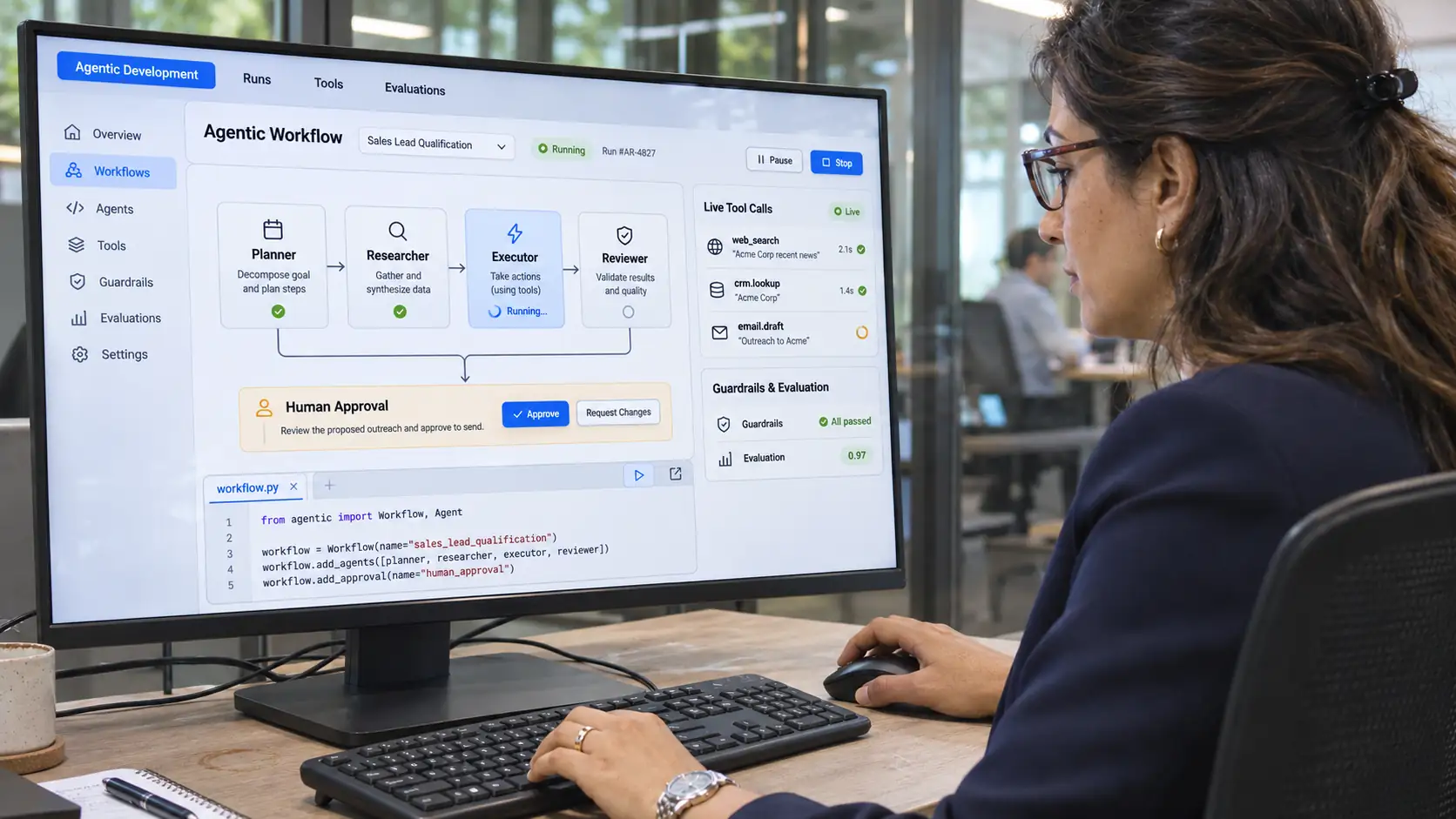
Has your team seen an agent perform well in a demo, then watched it stall on real work? Exceptions pile up, agents lose context when they hand work to each other, and nobody can say what an agent did or why. If that sounds familiar, you are in the right place. Cabot is an agentic AI development company that designs the whole system: the agents, the handoffs between them and the controls around them.
We start with one workflow, decide which steps need an agent and which need plain automation, then build agent orchestration with supervision and logging from day one. Every agent has defined permissions, every action is recorded, and a person approves the decisions that carry risk.
Healthcare is where this matters most. Hospitals, payers and health IT vendors need agentic workflow automation that keeps protected health information inside controlled environments. We build under HIPAA every day, and we bring the same discipline to enterprises in every other sector.
Workflow design · Agent teams · Orchestration · Integration · Supervision · Evaluation
Your details stay private.
What Is Agentic AI Development, and How Is It Different From a Single AI Agent, a Chatbot or RPA?
Agentic AI development is the design and build of software in which one or more AI agents plan steps, use tools and systems, and complete multi-step work toward a goal, with people setting the limits and approving the decisions that matter.
A chatbot answers questions. Robotic process automation follows a fixed script and breaks when the input changes. A single AI agent handles one task with some judgment. An agentic system coordinates several agents, each with a defined role, so a whole workflow can run from request to result. Multi-agent systems are useful when a process has steps that need different skills, such as reading a document, checking a policy, updating a record and drafting a reply.
An agentic AI development company is a partner that builds and runs that system for you. It picks the workflow, designs the agent team, sets what each agent may do, builds supervision and logging, and measures cost per completed task. For leaders, the test is simple: when an agent acts, can you see what it did, why it did it and who approved it.
Why Do Agentic AI Pilots Stall Before They Reach Production?
The demo to production gap. A pilot works on clean examples, then meets real documents, missing data and exceptions that no one planned for.
Handoff failures. When several agents pass work to each other, context gets lost, tasks loop or two agents do the same job twice.
No audit trail. Nobody can see what each agent did, so risk, compliance and finance teams will not sign off.
Runaway cost. Every model call and every retry adds up, and cost per completed task is never measured.
Integration and permissions. Agents need safe access to ERP, CRM or EHR systems, and broad credentials create real exposure.
Regulated data. Healthcare and financial data cannot be sent to tools that sit outside controlled environments.
Not sure a workflow is ready for agents?
Walk us through the process and we will show where agents help, where plain automation is enough and where a person must stay in the loop.
Which Agentic AI Development Services Can Cabot Deliver From First Workflow to Production?
Workflow discovery
We map the process, find the steps that suit agents and the steps that do not, and agree the measures of success before any build starts.
Agent team design
We define each agent's role, the tools it can use, what it may decide alone and where it hands off to another agent or a person.
Build and orchestration
We build the agents and the orchestration layer that routes work, shares context and handles failures, retries and exceptions.
Integration
We connect agents to your ERP, CRM, EHR and data stores through scoped permissions. See our AI integration services.
Supervision and evaluation
We add approval gates, logging, tracing and test suites that score agent behavior on real cases before and after release.
Run and improve
We monitor cost, accuracy and exceptions in production, then tune prompts, tools and routing as the workflow changes.
Have a process in mind?
Share it in a few lines and we will tell you what an agent team could take on in the first release.
What Does Agentic AI Development Cost, and What Moves the Price?
Seven things move the price: the number of workflows, the number of agents in each, the systems they connect to, the models you choose, your security and compliance requirements, the volume of work per month and how much human review you want. Model usage grows with every call and loop, so we measure cost per completed task from the first pilot. Share your scope and we will give you a range you can take to your finance team.
How Much Autonomy Should an Agent Have, and What Stays Human?
Three rules govern how we work. We use the models and frameworks you choose, and recommend them only when you have no preference. A qualified person approves every high-risk agent action before it takes effect. And we do not use your data to train any model.
Which Models, Frameworks and Platforms Does Cabot Use to Build Agentic Systems?
We work with the tools your teams and security policies already allow, and suggest others only when there is a clear gain. Healthcare projects add the controls that keep protected data out of prompts and logs. Where retrieval over your own documents is part of the design, see our RAG development services. For custom models, see our LLM development services. The groups below show what we build with. The table after them shows where agents sit at each stage.
Orchestration frameworks
Models
Cloud platforms
Observability and evaluation
Where Agents Help at Each Stage, and What Stays Human
Every stage has a clear owner and something you can inspect.
RPA, a Single AI Agent or an Orchestrated Agentic System: Which Fits Your Workflow?
Comparing approaches or vendors?
Share your shortlist and your constraints, and we will give you a plain view of where each option fits.
Which Industries Benefit Most From Enterprise Agentic AI?
Healthcare
Prior authorization, claims, referrals and clinical documentation involve many systems and strict privacy rules. Agents must keep protected health information inside controlled environments and leave a record for every action. See healthcare integration services.
Financial services
Onboarding, reconciliation and dispute handling need traceable decisions and clear limits on what an agent can approve.
Insurance
Intake, policy checks and claims triage depend on reading unstructured documents and routing exceptions to adjusters.
Manufacturing and supply chain
Order changes, supplier messages and inventory exceptions cross ERP and logistics systems on tight timelines.
Retail and logistics
Returns, shipment exceptions and customer requests arrive in volume and need fast, consistent handling.
Software and IT services
Support triage, incident response and internal operations benefit from agents that work across ticketing and monitoring tools.
How Does Cabot Keep Agentic AI Secure, Compliant and Under Your Control?
Security comes first. Agents can act, so a weak control costs more than a weak answer. We set the rules before the first build: least-privilege access for every agent, approved tools only, secrets and personal data kept out of prompts, input and output filtering, audit logs of every action and a stop switch for each agent. Your data is never used to train any model.
Standards follow. We align controls to SOC 2, ISO/IEC 27001 and GDPR, and to AI guidance such as the NIST AI Risk Management Framework and the EU AI Act where they apply. For healthcare clients, we add HIPAA safeguards, minimum-necessary access to protected health information and traceability from request to outcome. Which standards apply depends on your sector and regions, and we confirm the list with your compliance team before work begins. To see how we govern data in AI systems, read our data governance and AI practice.
How Does Cabot Take an Agentic Workflow From First Idea to Production?
Cabot works in six steps, each ending in a decision you make. You can stop after any of them, and the first is worth having even if nothing follows it.
Not sure where to begin? Start with step 01 and pick the one workflow that will prove the value.
1. Choose the workflow
We rank candidate processes by volume, risk and value. You decide which one goes first.
2. Design the agent team
We define roles, tools, permissions and handoffs. You decide what each agent may and may not do.
3. Build a thin slice
We build the full path for a narrow set of cases, with logging on from the start. You decide whether it earns a wider scope.
4. Evaluate on real cases
We score accuracy, exceptions and cost per task against your baseline. You decide the quality bar for release.
5. Release with supervision
We launch with approval gates and monitoring. You decide how much autonomy each agent gets and when.
6. Run and expand
We tune the system, add workflows and train your leads. You decide what Cabot continues to run.
Ready to see what agents can run for you?
Start with workflow discovery and leave with a ranked list of candidates and a first design, whether or not you build with us.
Who Stands Behind the Agents Running Your Workflows?
Every engagement has named owners. A solution architect owns the agent design and tool choices. Senior engineers own the orchestration code and review every change. An evaluation lead owns the tests that prove agent behavior. A security lead owns access, filtering and compliance controls, and a delivery lead owns the cadence and keeps your leaders informed. Cabot's depth is greatest in four areas: multi-agent systems and orchestration, integration with ERP, CRM and EHR platforms, healthcare software under HIPAA, and evaluation and monitoring of AI in production. We work in your repositories and tools, hold regular reviews with your leads and document every design decision, so the knowledge stays with your organization.
Why Technology Leaders Choose Cabot for Orchestrated Agentic AI Development Services
Built for production
We design for exceptions, handoffs and failure from the first week, not after the pilot.
Oversight you can inspect
Tracing, logs and approval gates let risk and finance teams sign off. See our data governance and AI practice.
Cost per task, measured
We track what each completed task costs and set limits on loops and retries.
Your choice of model and framework
We use the models and tools you choose, or build a custom LLM when the use case needs one. See LLM development services.
Built for regulated work
Healthcare and other regulated teams get access controls and audit trails from day one. See healthcare integration services.
Fast to start
Workflow discovery on one process can begin within weeks. See AI development services.
Client Success Stories

AI-Accelerated Discovery to MVP for a HIPAA-Compliant Patient and Physician Marketplace
See how Cabot took a HIPAA-compliant, four-portal telehealth marketplace from discovery to a working MVP with licensure-aware booking, video, and payments.
Read the case study
Text2SQL with Streamlit
Learn how Cabot used Python and Azure OpenAI to build a Streamlit app that turns plain-English questions into SQL and delivers real-time answers for faster analysis.
Read the case study
FHIR Server & FHIR Auth Configuration for Secure API Access
See how Cabot built a FHIR-compliant server with Firely Auth (OAuth2/OpenID Connect) and MSSQL for secure, standards-based access to healthcare data.
Read the case study
Automated Patient Summary Generation and Eligibility Assessment
Cabot built an AI system to generate patient summaries, run eligibility checks, prioritize referrals, and deliver dashboards, cutting intake time and errors.
Read the case studyWhere Should You Start If Agentic AI Is Only Part of the Answer?
You need one focused agent with tight governance
One agent with tight limits is often the right first step when the task is narrow and the risk is high. See AI agent development services.
You need AI connected to the systems you run
Agents only help when they can reach your ERP, CRM or EHR safely, with scoped permissions. See AI integration services.
Your agents must answer from your own documents
Retrieval keeps agent answers grounded in your policies, records and files. See RAG development services.
You need a model built around your data
A custom model fits when general models cannot meet your accuracy or privacy needs. See LLM development services.
Your system is aging but still works
Modernize the core first when old code or architecture limits what agents can reach. See application modernization services.
You need a budget range before a conversation
Get a planning range for an agent build before you commit to a scope. Try the Cost Calculator.
Our Clients









Agentic AI development is the design and build of software in which AI agents plan steps, use tools and systems, and complete multi-step work toward a goal, with people setting limits and approving high-risk decisions. It differs from a chatbot, which answers questions, and from RPA, which follows a fixed script.
Look for five things: proof of delivery on multi-step workflows, a clear design for how agents hand work to each other, defined permissions and approval gates, tracing you can inspect and a way to measure cost per completed task. Ask what happens when an agent is wrong or stuck. A company that cannot answer has not run this in production.
An AI agent handles one task using a model and tools. Agentic AI usually means a system of coordinated agents that cover a whole workflow, with orchestration, shared context and supervision. A single agent can be the right answer for a narrow task, and our AI agent development services page covers that case.
Cost follows the number of workflows and agents, the systems they connect to, the models you choose, your security and compliance requirements, the volume of work and how much human review you want. A focused pilot on one workflow costs far less than a program across several. For a starting range, try our Cost Calculator.
Use plain automation or RPA when steps are fixed and inputs are structured. Use agents when the work involves unstructured input, judgment or exceptions that scripts cannot handle. Many workflows need both, so we design the mix step by step.
An orchestration layer routes tasks, passes shared context and sets limits on loops and retries. Each handoff is logged, so you can trace a task from request to result. We test handoffs on real cases before release.
Each agent gets least-privilege access, approved tools only and clear limits on what it can decide alone. High-risk actions need a person's approval, every step is logged and each agent has a stop switch. We never use your data to train a model.
Yes. We keep protected health information inside controlled environments and out of prompts and logs, restrict access to the minimum necessary, record every agent action and keep traceability from request to outcome. We confirm the controls with your compliance team before work begins.
Through scoped API connectors and service accounts with only the permissions each agent needs. We map each system's rules, test in a sandbox first and log every call. If the integration itself needs larger work, we scope it through our AI integration services.
It depends on the workflow, the systems involved and your approval requirements, so we do not promise a fixed number. We build a thin slice for a narrow set of cases first, evaluate it on your real data and then widen the scope, so you see results before you commit to more.