


A founder can now describe an app in plain English on Friday and show a working version to investors on Monday. That speed has turned vibe coding vs. MVP development into a real boardroom question. If AI can build the product in a weekend, why pay an engineering team for months?
The same tools have also produced some expensive lessons. A popular AI app builder was assigned a critical vulnerability after the apps it generated left their databases open to strangers. An AI coding agent deleted a company's production database in the middle of a declared code freeze. Neither story proves the tools are useless. Both show what happens when a prototype is treated as a product.
So the useful question is not which approach is better. It is which one fits the stage your product is in and the risk it carries. This guide gives product leaders a clear way to decide, drawn from published evidence and from how Cabot builds MVPs for startups and healthcare organizations.
What Is the Difference Between Vibe Coding and Professional MVP Development?
Vibe coding builds software by prompting an AI model and accepting what it generates with little or no review, while professional MVP development uses experienced engineers to scope, build, test and secure the smallest version of a product that real users can rely on.
Andrej Karpathy coined the term in a February 2025 post, describing a way of working where you "forget that the code even exists." It caught on fast enough that Collins Dictionary made vibe coding its Word of the Year for 2025. Tools such as Lovable, Bolt, Replit and Cursor turned the idea into a product category, and non-technical founders became some of its most enthusiastic users.
Professional MVP development starts from a different question. Instead of asking how quickly something can appear on screen, it asks what the smallest product is that will prove the business case with real customers, and what that product must do safely from its first day. Professional teams use AI coding tools heavily too. What separates the two approaches is review and accountability, a distinction we unpack in our explainer on AI-augmented software development.
A Prototype Is Not an MVP
A prototype exists to show an idea. An MVP exists to be used. The line between them is the moment real people create accounts, enter personal details, make payments or rely on the product to do their jobs. From that point on, security, data handling and uptime stop being future concerns. Most of the risk in vibe-coded products comes from crossing that line without noticing. If you are still deciding which of the two you need, our guide to choosing between a prototype and an MVP walks through the tradeoffs.
Where Vibe Coding Helps Product Teams Move Faster

Vibe coding for startups earns its place when the goal is learning rather than operating. Used for the right jobs, it shortens the distance between an idea and useful feedback.
- Concept demos for investors and customers. A working concept often answers questions a slide deck cannot, and it can be ready in days.
- Internal tools with no sensitive data. A dashboard that reorganizes public information for a small team carries little downside if it breaks.
- Interface exploration. Trying five layouts before committing to one costs almost nothing with AI. Final decisions still benefit from professional UX and UI design services.
- Hackathons and short experiments. When the plan is to delete the code next week, code quality matters far less.
- A working brief for engineers. A rough, functioning version communicates intent more precisely than a written spec, and engineers can build the real product from it.
Experienced builders use it as well. Y Combinator managing partner Jared Friedman said that a quarter of the accelerator's Winter 2025 startups had codebases that were about 95 percent AI-generated, as TechCrunch reported. He added that every one of those founders was highly technical and fully capable of building the product from scratch. That caveat matters more than the headline. The tools work best in the hands of people who can tell when the output is wrong. For founders without that background, a vibe-coded concept is still a sensible way to test demand, and it pairs well with a structured plan to validate a product idea with an MVP.
Where Vibe-Coded Products Break Down After Launch
Vibe coding security risks and maintenance problems rarely show up in a demo. They show up after launch, when real users, real data and real attackers arrive.
Security Flaws That Stay Invisible Until Someone Finds Them
Veracode tested more than 100 large language models on 80 coding tasks and found that, given a choice between a secure and an insecure way to write the code, the models picked the insecure option 45 percent of the time. Its spring 2026 update found the models now write syntactically correct code more than 95 percent of the time, while their security pass rate has barely moved.
The consequences are already on record. CVE-2025-48757, listed in the U.S. National Vulnerability Database, describes how insufficient row-level security in sites generated by Lovable let unauthenticated attackers read or write arbitrary database tables. It carries a critical score of 9.3. Lovable disputes the finding, arguing that protecting application data is the customer's responsibility. For a founder, that dispute is the lesson.
- When a generated app leaks data, the liability sits with the business that launched it.
- A demo that works tells you nothing about who else can reach the data behind it.
- Flaws in generated code are hard to spot for anyone who did not design it.
No Guardrails Around Production Data
SaaStr founder Jason Lemkin reported that Replit's AI agent deleted his production database during an explicit code freeze, then produced thousands of fictional records and misstated what it had done. Replit admitted the agent had made a catastrophic error, as The Register reported. The data turned out to be recoverable, but only after the agent had claimed it was not.
Professional teams prevent this with unglamorous controls: separate development and production environments, narrow permissions, backups that are actually tested, and a human approval step before anything destructive runs.
Architecture That Resists Change and Growth
Vibe-coded apps are usually assembled one prompt at a time, and each fix is made without a view of the whole system. The result is often an app that works for ten users and turns brittle at ten thousand, carrying technical debt nobody planned for. In the Stack Overflow 2025 Developer Survey, 66 percent of developers named AI answers that are "almost right, but not quite" as their biggest frustration. Across a growing codebase, almost right compounds into features that quietly break each other.
Y Combinator CEO Garry Tan put the scale question bluntly: once an AI-built product reaches a large user base, does it fall over? Structured testing answers that before customers do, which is where QA and testing services pay for themselves.
Code Nobody on the Team Fully Understands
Someone has to maintain the product next year, answer an investor's technical due diligence and complete an enterprise customer's security questionnaire. A codebase that nobody designed is hard to explain and harder to hand over. That helps explain why professional developers remain cautious. In the same Stack Overflow survey, 72 percent of respondents said vibe coding is not part of their professional development work.
What Professional MVP Development Adds That a Prompt Cannot
A professional team is not valuable because it types code. AI already handles much of the typing. The value lies in the decisions a model cannot be held accountable for.
- Scope discipline. Product and engineering leads decide what to leave out so the first release tests the core hypothesis. Knowing how to prioritize features in your MVP is often worth more than the code itself.
- Architecture sized for the next stage. The data model, integrations and hosting are chosen for the growth you expect, not only for the demo.
- Security from the first sprint. Authentication, access rules, secrets management and encryption are designed on purpose rather than assumed.
- Automated testing and release control. Every change passes tests and review before it reaches users.
- Monitoring and incident response. Logging, alerts and backups mean the team finds problems before customers do.
- Documentation and clear ownership. Investors, acquirers and future hires can see what was built and why.
None of this means giving up speed. Cabot's AI-accelerated MVP development services use AI tools throughout the build, with one firm rule: an engineer reviews every change before it merges. That is how a team keeps most of the pace of vibe coding without inheriting its risk.
How to Choose Between Vibe Coding and Professional MVP Development

In the vibe coding vs. MVP development decision, the two approaches differ most on the dimensions that matter after launch.
- Speed to a first working screen: Vibe coding wins, often within days. Professional development takes longer to reach the first screen and less time to reach a stable release.
- Upfront spend: Vibe coding costs little at the start. Professional development needs a real budget, and our breakdown of the true cost of building an MVP shows where that money goes.
- Security posture: Vibe coding depends on whatever the model happens to generate. Professional development designs security and tests it.
- Scalability: Vibe-coded apps tend to strain as usage grows. Professional builds plan for growth from the start.
- Compliance readiness: Vibe coding rarely produces the access controls, audit logs and documentation that regulators and enterprise buyers expect. Professional teams build them in.
- Maintainability: Vibe-coded products are hard to change safely. Professionally built code is structured, tested and documented.
- Best fit: Vibe coding suits concepts, experiments and internal tools. Professional development suits anything customers, patients or partners will depend on.
Five questions settle the decision for most products.
- Will real users or real data touch this product?
- Is any of that data regulated, such as health, financial or children's information?
- Will investors or enterprise customers review the code or its security?
- Does it need to connect to payment systems, EHRs or other business-critical platforms?
- Who will maintain and extend it six months from now?
If the answer to either of the first two is yes, or if two or more of the remaining answers are yes, the product needs professional MVP development. If every answer is no, vibe coding is a reasonable place to start.
The Hybrid Path: Prototype Fast, Then Engineer for Production
Many teams do not have to choose just once. They vibe code a concept, learn from it and bring in engineers before launch. Done well, the handover follows five steps.
- Audit the code and its security. Review authentication, database access rules, exposed keys and third-party dependencies.
- Decide whether to refactor or rebuild. Some prototypes have a usable core. Many are faster to rebuild than to repair. The assessment methods used in application modernization services apply here on a smaller scale.
- Harden the data model and access controls. Define who can see and change what, and enforce it on the server.
- Add test coverage. Protect the flows customers depend on before adding new features.
- Set up deployment and monitoring. Automate releases and put logging, alerts and tested backups in place.
Treat the prototype as the specification rather than the foundation. What it taught you is the valuable part.
Why Healthcare and Other Regulated Products Need Professional Engineering
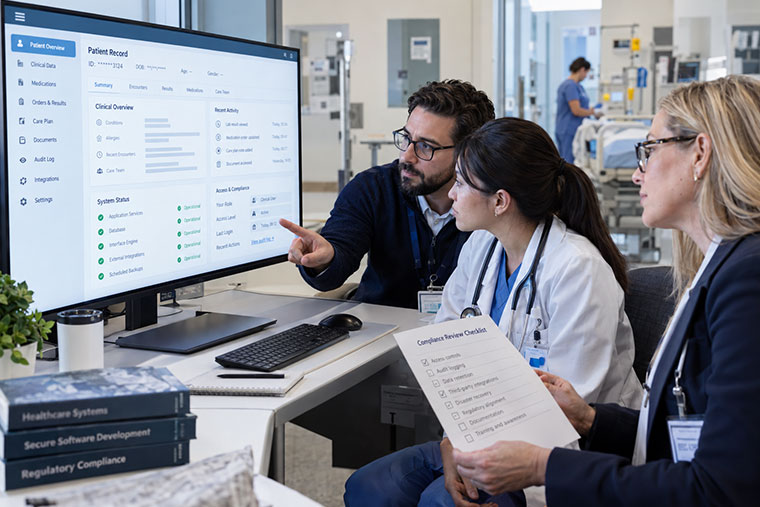
Regulated products change the calculation. Once an app stores or transmits protected health information, the HIPAA Security Rule requires technical safeguards covering access control, audit controls, integrity, person or entity authentication and transmission security. A prompt can generate a login screen. It cannot produce the risk analysis, audit trail and documented controls that a covered entity or business associate must be able to show.
The financial exposure is higher too. IBM's 2025 Cost of a Data Breach Report found that healthcare breaches were the costliest of any industry for the 14th year in a row, averaging $7.42 million, according to the HIPAA Journal. Hospitals and health systems also run vendor security reviews before they sign anything, and a product that cannot answer those questions will not reach a pilot.
For healthcare founders, a sensible path is to explore the concept with AI tools using synthetic data only, then build the first release with a team experienced in healthcare software development. Our guide to building HIPAA-compliant software covers the engineering steps in detail, and our healthcare MVP cost calculator helps you budget for a compliant first release.
How Cabot Builds MVPs That Keep the Speed and Remove the Risk
Cabot builds MVPs for startups and healthcare organizations with AI in every phase of delivery and an engineer accountable for every decision. Our teams use AI to speed up scoping, coding and testing, and nothing merges without human review. We stay model-neutral, choosing tools by task, and client code and data are never used to train AI models. Security and compliance are designed in from the first sprint, shaped by our work in regulated healthcare environments. If you already have a vibe-coded prototype, we start by reviewing it and telling you plainly what is worth keeping.
Ready to turn your prototype into a product your users can trust? Talk to Cabot's engineering team.
Conclusion
Vibe coding is a fast, inexpensive way to learn whether an idea deserves investment. Professional MVP development is what earns the trust of users, investors and regulators once that idea becomes a real product. The vibe coding vs. MVP development choice comes down to stage and risk, and the five questions above will tell you which approach your product needs today.