


Introduction
In modern healthcare, hospitals juggle high-acuity patient loads, regulatory mandates like HIPAA and NABH, and the need for seamless interdisciplinary care. Paper-based workflows once standard for charting, orders, and audits now create bottlenecks in data flow and decision-making. AI-integrated digital systems, leveraging standards like HL7 FHIR for interoperability, automate these processes, slashing administrative overhead by up to 40% (per recent HIMSS studies) while boosting clinical accuracy.
At the heart of this digital transformation are AI-driven solutions like Cabot’s Voice AI, Patient Intake automation, and integrations, designed to replace inefficient, manual processes with fast, secure, and accurate digital workflows. This blog details the technical pitfalls of paper systems and how AI-driven digital workflows mitigate them, improving throughput, safety, and compliance without disrupting clinical routines.
Technical Drawbacks of Paper-Based Workflows
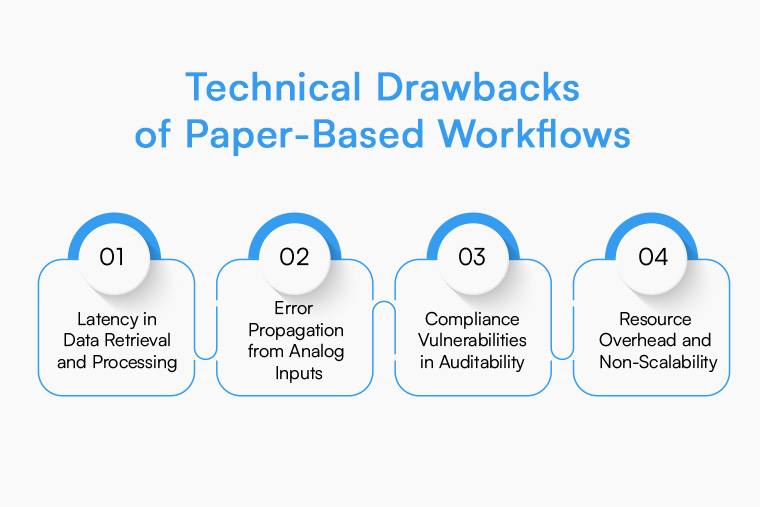
Paper workflows introduce latency, error propagation, and non-scalable data handling. Key issues include:
1. Latency in Data Retrieval and Processing
The physical chart pulls an average of 5-10 minutes per query, delaying interventions like stat labs or handoffs. Manual transcription to EHRs doubles this effort, with error rates up to 18% from dual entry. Cabot’s AI-powered Patient Intake solution automates data entry, directly transferring patient information from intake forms into structured EHR fields, reducing latency, and enhancing the speed of clinical decision-making. Additionally, Voice AI simplifies communication by extracting real-time data from voice interactions, ensuring information is immediately available for patient care.
2. Error Propagation from Analog Inputs
Illegible handwriting causes 12% of medication errors (ISMP data). Misfiling or transposition risks compound in high-volume wards. Machine learning (ML) models, trained on de-identified datasets, parse and validate inputs via natural language processing (NLP), flagging anomalies like mismatched vitals before they reach clinical decisions. Cabot’s Voice AI can play a critical role here: voice commands and dictation are transformed into accurate, structured data, mitigating the risk of human error and improving the quality of patient data entered into EHRs.
3. Compliance Vulnerabilities in Auditability
Paper lacks immutable logs, exposing gaps in chain-of-custody for PHI under HIPAA. Physical storage risks breaches via loss or theft. Digital audit trails via blockchain-like ledgers track every access with timestamps and role-based permissions, simplifying NABH audits and reducing violation fines. With Cabot’s solutions, such as Voice AI for secure voice-based data collection and automated patient intake, hospitals can maintain an airtight digital audit trail for compliance with real-time access logs, improving both security and audit preparedness.
4. Resource Overhead and Non-Scalability
Storage consumes 20-30% of admin space; labor for filing/retrieval hits $5-10 per record annually. As bed counts rise, this scales linearly unsustainable without digital compression and cloud archiving. With Cabot’s AI-driven Patient Intake system, hospitals can automate routine administrative tasks and store patient data securely in the cloud, reducing both physical storage needs and administrative labor. AI solutions like Voice AI further reduce resource overhead by automating routine calls, appointment reminders, and patient communications.
Advantages of AI-Enhanced Digital Workflows
AI systems built on NLP, predictive analytics, and RPA transform workflows into real-time, interoperable pipelines. Here's the clinical payoff:
.png)
ROI from Implementing AI-Enhanced Digital Workflows in Healthcare

Beyond operational efficiencies, the ROI of adopting AI-driven solutions for healthcare is not just about cost savings, it’s about optimizing the entire care process, improving patient outcomes, and achieving long-term sustainability. Here’s how AI-driven workflows in specific projects translate into ROI:
- Voice AI-Enhanced Patient Intake and Scheduling:
- Cost Savings: Automating patient intake and scheduling reduces administrative workload, leading to a 40% reduction in administrative overhead (HIMSS studies). Hospitals no longer need as many staff for manual data entry, and can allocate resources to patient care.
- Improved Throughput: AI cuts 25-30% of the time spent on administrative tasks, freeing up time for clinicians to spend more time on patient care. This allows hospitals to increase patient throughput without additional costs.
- Error Reduction and Patient Safety:
- Reduced Adverse Events: Implementing AI-driven systems for real-time data validation and decision support leads to a 15-20% decrease in adverse events related to medication errors, incorrect dosages, and misdiagnoses.
- Cost Avoidance: Fewer errors mean reduced litigation costs, fewer hospital readmissions, and better patient outcomes, contributing to cost savings in the long run.
- Digital Audit Trails for Compliance:
- Faster Audit Preparation: AI-powered digital systems automate the generation of audit logs and compliance reports, saving up to 80% in time spent on audit preparation. Healthcare providers also reduce the risk of non-compliance fines.
- Compliance Assurance: Implementing AI for real-time compliance monitoring ensures that hospitals remain compliant with regulations like HIPAA and NABH, avoiding costly penalties and improving audit readiness.
- Scalable Cloud Infrastructure:
- Cost Efficiency: Cloud-based solutions for storing patient records and other key data reduce the physical space required for paper storage. Healthcare providers can reduce storage costs by 50-70%, according to Gartner, without compromising data security.
- Elastic Scaling: AI-enhanced workflows are highly scalable, allowing hospitals to handle 10-20% yearly growth in patient volume without the need to hire additional administrative staff. This scalability ensures hospitals can accommodate rising demand without significant cost increases.
Conclusion: Prioritize Digital Transformation Now
Paper workflows are a legacy of liability, amplifying risks in an era of value-based care. AI-digital hybrids deliver measurable wins: faster decisions, fewer errors, ironclad compliance, and leaner operations. The ROI from transitioning from paper to AI-enhanced digital workflows is clear—hospitals can achieve substantial financial savings, improve patient care, and meet stringent compliance requirements.
Start with pilot modules like automated H&P digitization or AI-powered patient intake to build momentum and see tangible results in a short time.
Ready to pilot AI workflows in your unit? Embrace Cabot's solutions from Voice AI to Patient Intake automation and experience the future of healthcare today.