
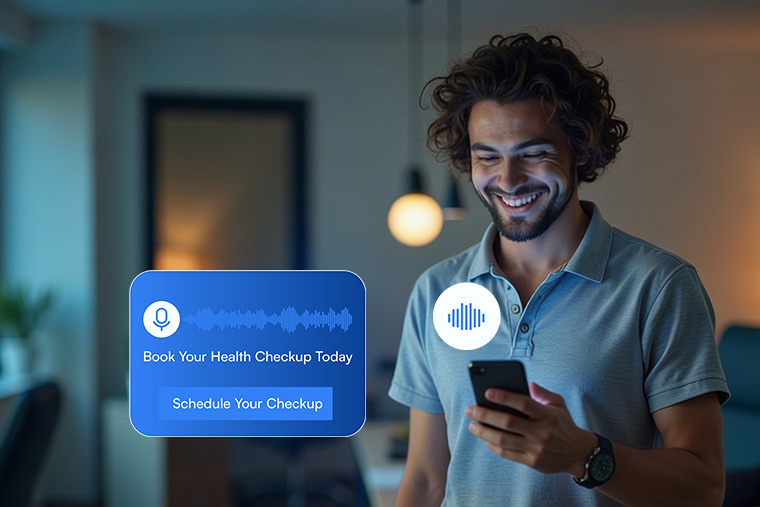
Voice AI for Healthcare Facilities UK

AI-powered voice technology that streamlines clinical workflows, enhances patient safety and frees staff to focus on care.

About Our Voice AI Solution for UK Healthcare Facilities

Healthcare leaders across the United Kingdom face constant pressure to improve patient outcomes while containing costs and meeting strict regulatory requirements. Our Voice AI platform has been engineered specifically for NHS trusts, private hospitals, community clinics and long-term care facilities. By converting spoken interactions into structured, actionable data in seconds, the solution removes time-consuming manual documentation and unlocks new insights for data-driven decision-making.

The technology integrates seamlessly with electronic patient record (EPR) systems such as Cerner, Epic and EMIS, enabling clinicians to dictate notes, populate forms and retrieve critical information without breaking eye contact with patients. Our clinically validated natural-language understanding (NLU) models recognise complex medical terminology and UK-specific drug vocabularies, ensuring accuracy that meets CQC and GDPR standards.

Beyond documentation, our Voice AI supports hands-free task management, medication reminders and real-time alerts for potential adverse events. Detailed analytics dashboards help executives monitor operational efficiency, staff workload and patient satisfaction in one centralised view. From busy A&E departments to community mental-health services, our Voice AI platform is transforming the way UK healthcare facilities deliver care—safely, securely and at scale.

Our Technology Stack

Speech Recognition Engines
Google Cloud STT, Microsoft Azure Cognitive Services, Amazon Transcribe

Natural-Language Understanding
spaCy, AWS Comprehend Medical, Microsoft Text Analytics for Health

Integration Frameworks
HL7, FHIR, REST, SOAP

Cloud Platforms
Microsoft Azure UK South, AWS London, Google Cloud Europe-West2

Frontend Frameworks
React, Angular, Web Components

Mobile Technologies
Swift (iOS), Kotlin (Android), React Native

Data Visualisation
Power BI, Tableau, Grafana

Security & Compliance
ISO 27001, ISO 13485, NHS DSP Toolkit

Databases
PostgreSQL, MongoDB, Azure SQL

DevOps & CI/CD
Azure DevOps, GitHub Actions, Docker, Kubernetes

Testing Frameworks
Jest, Cypress, Postman, Selenium

Monitoring & Logging
Azure Monitor, Prometheus, ELK Stack

Schedule a 30-minute discovery call with our clinical AI team

Why Partner with Cabot for Voice AI in UK Healthcare

Cabot has spent more than a decade delivering mission-critical digital health solutions to NHS trusts, private providers and life-science organisations across the UK. Our multidisciplinary team unites clinical informatics specialists, speech-science PhDs and software engineers who understand both the rigour of regulatory compliance and the nuances of day-to-day clinical practice.

We do not offer a “one-size-fits-all” product. Instead, we conduct detailed workflow assessments, stakeholder interviews and technical audits to configure Voice AI that aligns precisely with your care pathways. Whether your priority is improving triage accuracy in emergency departments, accelerating discharge summaries or supporting remote patient monitoring, our platform can be tailored to meet your objectives.

Quality and safety sit at the core of everything we build. Our solution is developed under ISO 13485 and ISO 27001 certifications, with data processed exclusively in UK-based, NHS-compliant cloud environments. We maintain continuous model-performance monitoring and provide clinicians with transparent confidence scores to build trust in AI-generated content.

Most importantly, we measure success by outcomes, not licences sold. Our clients typically achieve a 25 % improvement in documentation completeness, a 15 % reduction in readmission rates and higher staff satisfaction within the first six months. With Cabot, you gain a long-term innovation partner committed to safer, smarter and more human-centred care.

Our Implementation Process

  1. Initial Consultation
    We clarify your objectives, existing systems and compliance requirements.
  2. Workflow Mapping
    Our clinicians shadow staff to document current processes and pain points.
  3. Solution Design
    We configure Voice AI modules, data flows and integration points.
  4. Pilot & Validation
    Run a controlled pilot, gather feedback, fine-tune models and measure KPIs.
  5. Full Roll-Out
    Scale across departments with robust training, change-management and support.

Our Industry Experience

volunteer_activism

Healthcare

shopping_cart

Ecommerce

attach_money

Fintech

houseboat

Travel and Tourism

fingerprint

Security

directions_car

Automobile

bar_chart

Stocks and Insurance

flatware

Restaurant

Contact Us for More Details!

Frequently Asked Questions

Below are answers to common queries from healthcare leaders evaluating our Voice AI for Healthcare Facilities UK.

  1. How accurate is the speech recognition in a busy clinical environment?
    • Our models are trained on thousands of hours of UK clinical audio, achieving >96 % accuracy even with background noise.
    • We support custom vocabulary updates for trust-specific terminology to maintain peak performance.
  2. Will Voice AI integrate with our existing EPR?
    • Yes. We provide certified HL7 and FHIR connectors for leading UK systems such as Cerner, Epic and EMIS.
    • Our team handles all configuration, testing and validation to ensure zero disruption to live operations.
  3. How do you ensure data security and GDPR compliance?
    • All data is encrypted in transit and at rest within UK-based, NHS-approved cloud environments.
    • We complete Data Protection Impact Assessments (DPIAs) and adhere to the NHS DSP Toolkit.
  4. What is the typical implementation timeline?
    • A focused pilot can be deployed in 8–10 weeks, with full roll-out following successful evaluation.
    • Timelines vary depending on integration complexity and change-management requirements.
  5. How is ROI measured?
    • We track documentation time saved, reduction in transcription costs, clinician satisfaction scores and clinical-risk alerts avoided.
    • Dashboards provide transparent metrics to justify ongoing investment.