
Outcome-Led Agile Software Development Services
Sprints that end in shipped software, not a status update.
You are almost certainly running agile already. The standups happen, the burndown falls, and the release the business is waiting for is still two quarters out. What costs you the quarter is not the framework. It is a sprint set up to produce activity rather than a decision.
Cabot's agile software development services put a cross-functional squad on your product that ships working software every two weeks, agrees in writing what finished means before the first ticket is opened, and prices every scope change the moment it is raised. You watch the board, the repository and the test results from day one rather than hearing them summarized at a demo.
Most engagements start with a single scoped increment covering discovery and sprint zero, so you can judge the squad on real output before committing to a build. Tell us what needs to ship and by when, and we will come back with a squad shape, a first sprint goal and the risks we can see.
No obligation. Your details stay private.
Thank you! Your submission has been received!
Oops! Something went wrong while submitting the form.
What agile software development services actually buy you
Agile software development services are an engagement in which an outside engineering team plans, builds, tests and releases your software in short repeating cycles, so working software reaches real users every few weeks and the plan is corrected by evidence rather than defended until the contract ends.
The definition matters because the market has quietly replaced it. Agile in the original sense is a set of commitments about how decisions get made: working software is the measure of progress, requirements are allowed to change late, and the people building the thing talk directly to the people who need it. Standups, story points and two-week iterations are conventions that grew up around those commitments. They are not the commitments themselves, which is why a team can perform every ritual faithfully and still be running a waterfall project in fortnightly slices.
So the useful question to ask a prospective partner is not which framework they use. It is what happens on their projects when the evidence says the plan was wrong. A team practicing the method changes the plan and tells you what that costs. A team practicing the ceremonies files a change request and keeps building. Everything on this page is our answer to that question. Our agile software development services sit inside Cabot's wider product engineering practice.
Why agile stops working once someone else is running it
These are the six failures buyers describe when they come to us for agile software development services. None of them is caused by choosing the wrong framework, and none is solved by adding another ceremony.
- Every ritual runs and nothing reaches users. Standups, refinement, review and retro all happen on schedule, and months pass without a release a customer could notice. Process compliance has become the deliverable, and it is being reported as progress.
- Velocity climbs while the roadmap stands still. Story points completed per sprint rise steadily, and the three outcomes the board is waiting for have not moved. The number being optimized is a measure of effort, and it has quietly replaced the measure of value.
- Built to the ticket, not to the need. What was delivered matches the acceptance criteria exactly and is not what the business needed. The team never held the underlying intent, so every ambiguity in a ticket was resolved the cheapest way rather than the right one.
- Three hours of overlap sets the pace. A decision that would take four minutes in a shared room takes a day and a half across a timezone gap. Nobody logs the delay, so the cost never appears anywhere, and the plan keeps assuming a speed the arrangement cannot produce.
- A firm estimate that quietly became open ended. The engagement started against a fixed number, absorbed a run of reasonable changes, and is now time and materials in everything but name. No single change was unreasonable, and nobody priced them as they arrived, so the ceiling disappeared.
- The context leaves when the engineer does. One person rotates off and the team spends weeks rediscovering why a subsystem works the way it does. The reasoning lived in someone's head and in chat history, and neither survived their last day.
The agile software development services we deliver
Three ways to engage our agile software development services, each scoped to where you actually are. Some clients need a squad to build a product. Others have a practice that is not producing and need it repaired. As an agile software development company we do both, and we say which one we think you need before you sign anything.
Three further capabilities run inside every engagement rather than as separate lines you buy. Testing sits in the sprint with an automated suite that grows alongside the product, backed by our QA and testing practice for performance, security and regression at scale. Environments, pipelines and release automation make shipping routine rather than an event, and where the platform itself needs work that runs through our cloud enablement team. And after launch the same squad keeps the product current, with a backlog fed by what real usage shows rather than by what was assumed during the original build.
Agile product development
A full cross-functional squad that owns a product from discovery through release. Product engineering, quality and delivery accountability sit inside one team rather than across three organizations with handovers between them.
Scrum teams and Kanban squads
A scrum team or a Kanban squad that joins your existing cadence and works to your definition of done. Scrum where the work benefits from a fixed rhythm and a committed sprint goal, Kanban where flow and interrupt-driven work matter more than a boundary every two weeks.
Agile transformation and coaching
For a practice that already exists and is not producing. Our agile transformation services begin by watching a real sprint before we recommend anything, then fix the specific mechanism that is broken, which is usually the definition of done, the flow of decisions, or the absence of a working test suite.
What does agile software development cost when the scope is allowed to move?
Cost tracks with the shape of the squad and how many sprints it runs, not a fixed package price. Scope changes are priced as they arrive, in sprints, so the ceiling stays visible instead of dissolving one reasonable change at a time. Get a quick figure in minutes, then tell us what needs to ship and we will scope it properly.
How we tell whether your agile practice is broken, and where
Most teams asking for help do not need a new framework. They need someone to find the one mechanism that is quietly stopping work from shipping. We watch a real sprint before we recommend anything, and we look at four things in a fixed order.
Is there a written definition of done
Whether finished is agreed in writing before work starts, or argued at the end of every sprint. Without it no two people build to the same bar, and a busy team ships nothing.
What happens to a change raised mid-sprint
Whether a change is priced against what it displaces, absorbed quietly, or filed and forgotten. This is where a firm estimate goes, and it shows in the first sprint we watch.
Does the test suite prove anything
How much of the suite covers the paths that matter, how long a run takes, and how often it is skipped near a deadline. A bypassed suite is a slower way of having no suite.
How long a decision takes to travel
The real elapsed time from a question being raised to it being answered, measured across the timezone gap rather than assumed. Delivery speed rarely exceeds decision speed.
The tooling a Cabot squad runs on
Our agile software development services run on three layers of tooling, chosen to fit your environment rather than ours. If your organization already standardizes on a stack, the squad works in it. The table further down sets out where AI sits in each stage of a sprint, what stays with a person, and which tools are involved.
What we work in:
Planning and collaboration
Jira
Azure DevOps
Confluence
Slack or Teams
Engineering and delivery
Git
GitHub Actions
Azure Pipelines
Docker
Terraform
Kubernetes
Quality and observability
Playwright
Jest
pytest
SonarQube
OpenTelemetry
Grafana
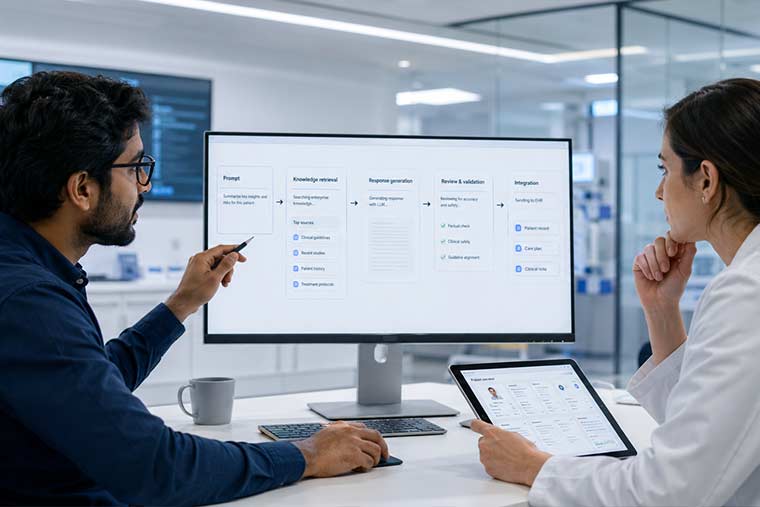
What does AI actually change inside a sprint?
The current evidence is more useful than the marketing. DORA's 2025 research found that AI adoption correlates with higher throughput and better product performance where strong engineering practice already exists, and correlates with worse delivery stability where it does not. AI amplifies what a team already is. On a disciplined team it removes drudgery. On an undisciplined one it produces more code, faster, in the places that were already fragile.
That finding decides how we use it. AI does the work where a wrong answer is cheap to catch and quick to fix: drafting test cases from acceptance criteria, generating the first pass of boilerplate and data access code, summarizing a long ticket thread into the decision it actually contains, and flagging code review issues a reviewer would rather not spend attention on. Every one of those outputs faces a test suite or a person within minutes.
It does not decide what to build, what finished means, or which trade-off to accept between a deadline and a design. It does not sign off a release. Those are the judgments you are engaging an engineering team for, and handing them to a model would be handing over the part of the work that carries the risk. The same research reports that around three in ten developers place little or no trust in AI-generated code, which is a reasonable position to hold and one our review rules assume rather than argue with.
Three rules govern every engagement. We are model neutral, choosing tools per task and replacing them as the field moves rather than committing your delivery to one vendor. A named engineer reviews every AI-assisted change before it merges, and that person is accountable for it exactly as if they had typed it. And we do not train models on your code or your data, under any arrangement. Digital.ai's November 2025 survey found only about half of organizations have clear AI usage guardrails in place, which is precisely why we put ours in the contract.
Where AI sits at each stage of a sprint, and where it does not
Each stage below has an output you can inspect and a person who approves it. Nothing an AI drafts reaches your repository or your users without a named engineer accepting it first.
| Sprint stage | What AI does | What stays human | Tools used |
|---|---|---|---|
| Backlog, discovery and planning | Summarizes long ticket threads and research notes into the decision each one contains, drafts acceptance criteria from a written intent, surfaces similar past work with its actual duration, and flags tickets whose description is too thin to estimate. | Deciding what the product should do and what is out of scope, committing to a sprint goal, sizing the work, and deciding what will not be attempted this sprint. | Claude, Jira AI |
| Build | Drafts boilerplate, data access layers and repetitive transformations, and completes code against patterns already in the repository. | Architecture, interface design, and any decision that will be expensive to reverse later. | GitHub Copilot, Claude Code, Cursor |
| Code review | Raises a first pass of issues: unhandled errors, missing null checks, obvious security patterns, style drift. | The merge decision. A named engineer signs off every change and owns it afterward. | GitHub Copilot, SonarQube |
| Test | Generates unit and integration test cases from acceptance criteria and proposes edge cases a person may not enumerate. | Deciding what must be tested, what risk is acceptable, and whether the suite proves anything worth proving. | Playwright, GitHub Copilot |
| Release and operate | Drafts release notes from merged changes and groups production errors into probable root causes. | Go or no-go, the rollout plan, and reading what live usage means for the next sprint. | GitHub Actions, Grafana |
How a Cabot squad differs from a typical agile vendor
Four dimensions on which agile software development services succeed or fail, chosen because they are where engagements go wrong rather than where they are easy to describe. Each row is a mechanism you can hold us to, not a promise.
The teams we build squads for
We run agile software development services across three markets. What follows is what we understand about each, rather than a claim to serve them.
Regulated and clinical products
In healthcare, a two-week cadence has to coexist with traceability from requirement to test to release. We know that evidence is far cheaper to produce inside the sprint than to reconstruct before an audit, and our healthcare software development practice runs on that assumption.
SaaS and product companies
Shipping to live users continuously means every release is also a migration for someone already mid-workflow. Feature flags, backward compatibility and a rollback that has actually been rehearsed matter more here than raw sprint throughput.
Enterprise programs with several vendors
A squad rarely arrives alone. It joins an internal team, a systems integrator and a platform group, each with its own release calendar. The integration points and the release train are the real work, and where the product is an app, that runs alongside our mobile app development services.
Industries we already understand
Healthcare
Ecommerce
Fintech
Travel and Tourism
Security
Automobile
Stocks and Insurance
Restaurant
How security and audit evidence stay inside the sprint
In our agile software development services, security is engineering work with a place in the definition of done rather than a review at the end. That means secrets handled through a managed store rather than configuration files, dependencies scanned on every build, static analysis in the pipeline, least-privilege access to environments, and a threat model revisited when the architecture changes rather than once at kickoff. Your IP and your code are yours from the first commit.
Regulatory obligations are scoped to your market rather than applied as a blanket. Where a product is regulated, the artifacts an auditor asks for are produced as the work happens: requirements traced to tests, test results retained per release, change history tied to an approval, and a documented reason for every architectural decision. For healthcare that means HIPAA safeguards and a business associate agreement, and our compliance practice covers the rest. For consumer data it means GDPR and CCPA behavior including deletion. For enterprise buyers it means a SOC 2 aligned process that can point at evidence rather than intent.
Secrets management
Dependency scanning
Static analysis in pipeline
Requirement traceability
HIPAA safeguards
SOC 2 aligned
How a sprint actually runs with us
Our agile software development services run to three stages, each ending in a decision you make rather than a document you receive. The point of the cadence is that you get a real choice every two weeks instead of one large choice at the start. Most engagements begin with a single scoped increment covering the first stage, so you can judge the working relationship before committing to a build.
Discovery and sprint zero
We establish the outcome the work is funded to move, shape a backlog against it, and cut what does not serve it. Architecture, environments, pipeline and a written definition of done are then agreed before feature work starts. You decide the first sprint goal and you sign off what finished means, and that document settles every scope argument for the rest of the engagement. Where the interface is the risk, design runs in the same cadence through our UX and UI design team.
Sprint delivery and continuous testing
Work lands in reviewable slices against the committed goal, and testing runs with the build rather than in a phase after it. Anything raised mid-sprint is priced against what it displaces, and you approve the trade rather than discovering it later. A named engineer reviews every change before merge, and you watch the test results and the pipeline throughout rather than hearing them summarized at a demo.
Release, measure and adapt
Working software goes to real users, and the release is measured against the outcome set at the start rather than against velocity. What live usage shows then feeds the next backlog, including the uncomfortable finding that a planned feature is no longer worth building. You decide whether the result justifies the next increment, and you reprioritize with evidence rather than with the original plan.
Who is on the squad and what each person owns
On our agile software development services engagements, accountability is explicit from the first day. A tech lead owns the architecture and the merge decisions and is answerable for every change that ships. Engineers own their slices end to end, build to release, rather than passing work to a separate integration group. A QA lead owns the automated suite and what it proves. A delivery lead owns the cadence, the sequencing and keeping your stakeholders informed between demos. You always know which person owns a decision, and you can reach them.
Our depth shows in four specific places. We are strong at building products in regulated environments where release evidence has to be produced as the work happens. We are strong at repairing an agile practice that runs the ceremonies without shipping, because the fix is usually mechanical rather than cultural. We are strong at test automation on codebases that arrived with almost none. And we are strong at running a squad alongside an internal team without the two quietly becoming one bottleneck. We do not claim equal depth in everything, and we will say where a specialist fits better.
On working hours, an offshore or distributed squad commits to a written overlap window with your team rather than leaving it to chance, and decisions that need you are batched into it so the day is not spent waiting. Architecture decisions are recorded in your repository as they are made, which is what keeps a rotation from costing you weeks. When the squad needs to grow, you can add engineers to the team already running rather than starting a second one from nothing.
Why technology leaders choose Cabot for outcome-led agile software development
Speed is only worth having if what arrives is sound. These are the six reasons buyers give when they explain why they moved their agile software development services to Cabot.
Working software early, in funded increments
You get something running in the first increment and a real decision point at the end of each one, so value arrives before the contract does rather than after it. The wider practice behind the squad is our digital transformation work.
We work inside your process, not ours
Scrum, Kanban, your board, your release train, your definition of done. We adapt to how your organization already ships instead of asking it to reorganize around a method we prefer.
Security and compliance built into the cadence
Controls and evidence are produced by the sprint rather than retrofitted before a review, so a regulated product is audit ready as it goes rather than after a scramble. Our compliance work sets the bar.
Cost that stays visible when scope moves
Every change is priced when it is raised and named against what it displaces. The number you were given at the start either holds or changes with your approval, and never erodes without one.
You watch the work, you are not briefed on it
Board, repository, pipeline and test results are open to you from the first sprint, and the engineers are reachable. Progress is something you check rather than something you are told.
AI in delivery with the review rules written down
We use AI where it earns its place and say exactly where it does not, with a named reviewer before every merge. If the product itself needs intelligence, that is our AI agent development practice, not this one.
Where to go next, depending on what is in your way
Agile software development services are the delivery model. What you actually need depends on which of these describes your situation.
The idea has to be proven before you fund a team
If the business case is not settled, prove it small and fast first with our MVP development services, then bring a squad to what survives.
The product exists and the codebase is what slows you down
If sprints keep stalling on a system that is risky to change, the constraint is the code rather than the cadence. That starts with application modernization services.
You have the method and you need more engineers
If your practice works and the shortage is capacity, you do not need a delivery model, you need people. That is extending your engineering team.
Our Clients





Questions technology leaders ask before starting
- What are agile software development services?
They are an engagement in which an outside engineering team plans, builds, tests and releases your software in short repeating cycles rather than in one long phase. In practice that means a cross-functional squad, a written definition of done, a release every few weeks, and a plan that changes when the evidence says it should. The terms agile development services and agile software development services describe the same engagement, and buyers use them interchangeably. The distinction that actually matters is between running the method and running the ceremonies, because only one of those produces shipped software.
- How much does agile software development cost?
Cost is driven by the shape of the squad and the number of sprints it runs, not by a package price. A small squad on a focused product costs a fraction of a multi-squad program with integration and compliance work, so any figure quoted before scoping is a guess. You can model your own range with our cost calculator, and we will scope it properly against your product before anything is committed.
- How does pricing work if the scope is allowed to change?
We fund the work in increments and price every change when it is raised. Each increment has a defined goal and a cost, and at the end of it you can continue, redirect or stop with a running system in hand. When something new comes up mid-sprint, we tell you what it displaces before it is accepted. That is what stops a firm estimate from turning into open-ended time and materials one reasonable change at a time.
- How soon will we see working software?
Typically at the end of the second sprint, so roughly four to six weeks from start, with sprint zero spent on architecture, environments and the definition of done. On a product with an existing codebase it can be sooner, because the pipeline already exists. If a partner selling agile software development services cannot tell you when the first release will reach a real user, that is worth pressing on before you sign.
- How do we keep control of scope with an agile vendor?
Through three mechanisms rather than trust. A written definition of done agreed in sprint zero settles what finished means. Every mid-sprint change is priced against what it displaces and approved by you. And funding is released in increments, so there is a real stopping point every few weeks. Scope escapes on agile software development services engagements when none of those exist and every change is absorbed silently.
- Can agile software development work in a regulated industry like healthcare?
Yes, and it usually works better than a phased approach, provided the evidence is produced by the sprint rather than reconstructed before the audit. That means requirements traced to tests, test results retained per release, change history tied to an approval, and design decisions recorded when they are made. Our healthcare software development engagements are built that way, with HIPAA safeguards and a business associate agreement in place from the start.
- What is the difference between agile software development services and hiring engineers to extend our team?
You are buying different things. Agile software development services buy a delivery model: a squad with its own accountability, cadence, quality bar and release process, answerable for an outcome. Extending your team buys capacity inside the practice you already run, with your leads owning the method. Choose the first when delivery itself is what is failing, and the second when your process works and you are short of people. If it is the second, start at extending your engineering team.
- How do you use AI in agile delivery, and who reviews the code?
A named engineer reviews every AI-assisted change before it merges and is accountable for it as though they wrote it. AI drafts tests, boilerplate and first-pass review comments, and summarizes long threads into decisions. It does not decide what to build, what finished means, or whether a release ships. We are model neutral, and we do not train models on your code or your data.