

Key takeaways
- An AI agent is one actor that plans and acts; agentic AI is the system around it.
- Gartner expects over 40% of agentic AI projects to be canceled by the end of 2027.
- Start with the simplest option: assistants for retrieval, automation for routine steps, agents only where decisions are needed.
- Set what each agent may do, log every action, and track cost per completed task before launch.
- Under HIPAA, access rules cover software programs, so every agent needs scoped access and audit records.
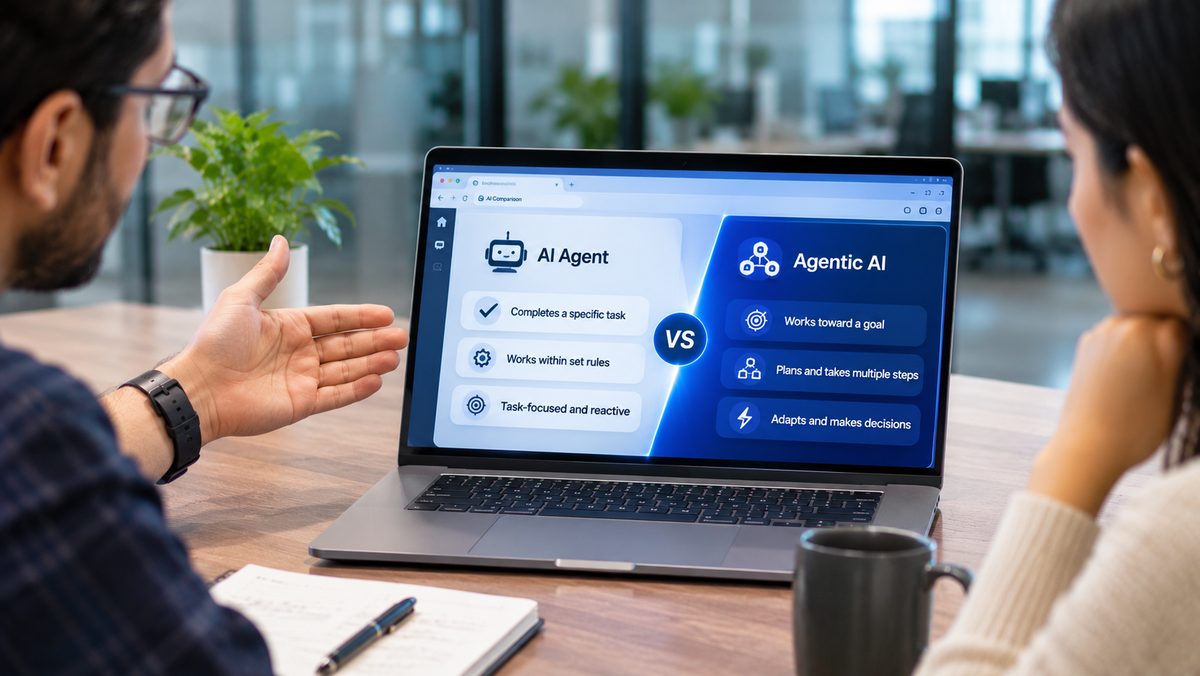
An AI agent is software that pursues a goal by choosing its own steps and tools, and agentic AI is the wider approach of building systems where agents plan, act and adapt with limited human direction.
Many vendor demos and briefings use the two terms as if they meant the same thing, and that is where budgets go wrong. In the agentic AI vs AI agents debate, the question that matters to a leader is not which label is correct. It is how much decision making you are handing to software, how many systems it can touch, and who answers for what it does.
This guide explains the difference between AI agents and agentic AI in the order a decision maker meets it. It covers why the terms get mixed up, what one agent can and cannot do, and what makes a system agentic. It then compares both with generative AI and robotic process automation, gives a rule for choosing between them, and explains what changes at the system level. Healthcare and regulated data get their own section, followed by what to ask before you buy. It is written for CTOs, COOs and operating leaders. The last section shows how Cabot helps.
Why Is Agentic AI vs AI Agents So Often Misunderstood?

Agentic AI vs AI agents is misunderstood because vendors apply both terms to almost anything with a language model attached, and the confusion shows up as wasted pilots, wrong purchases and unclear accountability.
Gartner has a name for the problem. In a June 2025 press release, it described "agent washing," the rebranding of existing products such as AI assistants, robotic process automation and chatbots without substantial agentic capabilities. Gartner estimated that only about 130 of the thousands of agentic AI vendors are real. The same release forecast that over 40% of agentic AI projects will be canceled by the end of 2027, because of escalating costs, unclear business value or inadequate risk controls. A Gartner analyst also noted that many use cases positioned as agentic today do not require agentic implementations. That is a forecast made in 2025, not a measured outcome, but the reasons it gives are the ones leaders should plan around.
When the two terms blur, three things tend to go wrong:
- Scope. A team asks for "an agent for X" when the real problem is a workflow that crosses several systems and roles. The pilot works in a demo and fails on exceptions.
- Budget. Money goes to an agent product when the missing piece is coordination, permissions and monitoring, or the reverse.
- Accountability. Nobody can say who approves an autonomous action, or how to find out later what happened.
Getting the vocabulary right is cheap. It is the first step toward every decision in the rest of this guide.
What Is an AI Agent, and What Can One Agent Do on Its Own?
An AI agent is software that uses a language model to pursue a goal, deciding its own steps, calling tools such as databases and business systems, and checking the results as it goes.
Anthropic's engineering team draws a useful line for the agentic AI vs AI agents question. It calls any system built on language models and tools an agentic system, then separates two kinds. In a workflow, models and tools follow predefined code paths. In an agent, the model dynamically directs its own process and tool use. If someone sells you an "agent" that always runs the same five steps in order, you have bought a workflow. It may be perfectly good, but it is a different product with different risks.
Typical agentic AI examples at the single agent level include:
- A support agent that reads a customer's order history and a knowledge base, then issues a refund within a set limit.
- A coding agent that edits several files, runs tests and iterates until the tests pass.
- In a healthcare practice, an agent that reads an incoming referral, checks it against the practice's intake rules and drafts a routing recommendation for a staff member to approve.
One agent is a good fit when a single decision maker can handle the task end to end with one set of tools. Its limits are just as clear. It works from one context, so it struggles when a job needs different permissions, different data sources and different checks at different points. Anthropic also warns that the autonomy of agents means higher costs and the potential for compounding errors, and recommends extensive testing in sandboxed environments with appropriate guardrails. A single agent is not a toy, but it is not a shortcut to automating a whole department either.
What Makes a System Agentic, and How Do Multi Agent Systems Work?

A system is agentic when it pursues a goal across several steps by planning, using tools and adapting to results. In multi agent systems, separate agents hand work to one another under a coordinating layer.
The agentic AI vs AI agents distinction matters in practice. A single agent is one worker. An agentic system is the structure that lets several workers cover a whole workflow without losing context or acting outside their limits. Anthropic describes one common pattern as orchestrator and workers: a central model breaks a task down as it goes, delegates the pieces to worker models and combines their results. The key feature is flexibility, because the subtasks are not fixed in advance.
Take a referral packet arriving at a specialty practice. One agent extracts the clinical and insurance details. A second checks the request against coverage and intake rules. A third proposes appointment options. A coordinating layer tracks the state of the case, passes information between them and sends any exception to a staff member. No single agent needs access to everything, and each one can be tested and monitored on its own job.
What the system layer adds is where the engineering effort goes:
- Shared state and handoffs, so context survives between agents.
- Limits on what each agent can read and change.
- Stop conditions, such as a maximum number of iterations, so a loop cannot run unchecked.
- Human checkpoints at the points where judgment is needed.
- A record of every action across the whole chain.
This is the layer our agentic AI development services focus on.
Where Does Agentic AI vs AI Agents Fit Beside Generative AI and RPA?
Generative AI produces content when asked, robotic process automation repeats fixed steps, a single AI agent chooses its own steps for one goal, and an agentic system coordinates agents across a whole workflow.
The comparison of agentic AI vs generative AI causes the most confusion, because agents are usually built on generative models. Generative AI answers a prompt and then waits. An agent uses that same capability to decide what to do next and then acts through other systems. The table sets agentic AI vs AI agents beside generative AI and scripted automation, and it answers the agentic AI vs RPA question along the way.
ApproachWhat it doesWho decides the next stepTypical exampleMain riskBest fitGenerative AI assistantCreates or summarizes content on requestThe person, with every promptDrafting a letter or summarizing a chart noteInaccurate output that nobody reviewsRetrieval and drafting with a person in the loopRPA or scripted automationRepeats a fixed sequence of stepsWhoever wrote the scriptMoving data between two systems on a scheduleBreaks when the process or inputs changeStable, rules based, high volume tasksSingle AI agentPursues one goal using toolsThe agent, within set limitsA support or intake agent with a refund or routing limitCompounding errors and rising costOne decision maker, one set of toolsAgentic systemCoordinates several agents across a workflowA coordinating layer plus human checkpointsReferral intake from packet to scheduled visitWeak handoffs, no audit trail, runaway costMulti step work across systems and roles
Two points follow from the table. First, none of these is simply better than another. Each fits a different kind of work. Second, they combine: an agentic system often contains a generative model, a retrieval step and a scripted automation alongside its agents. If your team works with retrieval, our RAG development services cover that layer.
Agentic AI vs AI Agents: Do You Need One Agent, a System or Plain Automation?
Use the simplest option that does the job. That means an assistant for retrieval, automation for routine steps, one agent when a decision is needed, and an agentic system only when several decisions must be coordinated.
Both Gartner and Anthropic point the same way. A Gartner analyst advises using AI agents when decisions are needed, automation for routine workflows and assistants for simple retrieval. Anthropic recommends finding the simplest solution possible and adding complexity only when it demonstrably improves outcomes, noting that agentic systems often trade latency and cost for better task performance. Four questions turn that advice into a decision:
- Can someone write down every step in advance? If yes, use automation or a fixed workflow.
- Is the job a lookup or a summary? If yes, use an assistant with retrieval and a person reviewing.
- Can one decision maker finish the job with one set of tools and one set of permissions? If yes, use a single agent.
- Does the job cross several systems, roles or approval points, with exceptions along the way? If yes, design an agentic system.
Then settle how much latitude each action gets. We use four levels of agent autonomy, described on our AI agent development services page: observe, advise, act with approval and act autonomously. The level is decided per action, not per agent. Reading a record might be fully autonomous while sending a message to a patient needs approval. Most business workflows settle in the middle levels, and an agent earns a higher level by showing a track record at a lower one.
What Changes When You Move From One Agent to an Agentic System?
In agentic AI vs AI agents terms, moving from one agent to a system shifts the hard problems from the model to the system. Handoffs, permissions, oversight, audit trails, cost and integration all multiply with every agent you add.
Plan for six changes:
- Handoffs. Context must travel between agents without being lost or distorted. Handoffs are where context is most easily lost or distorted.
- Permissions. Each agent should be able to read and change only what its job requires. An agent running on a broad service account turns one bad decision into a wide incident.
- Oversight. Decide in advance where a person approves, what happens when nobody responds, and who can stop the system. Anthropic notes that agents can pause for human feedback at checkpoints or when they hit a blocker.
- Audit trail. When someone asks what the system did last Tuesday and why, you need an answer that does not depend on anyone's memory.
- Cost. Because agents loop and retry, cost grows with every model call. Measure the cost per completed task, not the cost per call, and watch for loops.
- Integration. Gartner warns that integrating agents into legacy systems can be technically complex, often disrupting workflows and requiring costly modifications, and that rethinking the workflow from the ground up is often the better path. Our AI integration services start from that question.
Test all of it in a sandbox before production. An agentic system that has only been exercised on the happy path has not been tested.
What Do Agentic AI and AI Agents Mean for Healthcare and Regulated Data?
In healthcare, an agent that touches electronic protected health information has to operate under the same HIPAA technical safeguards as any other system, including access limited to granted rights, unique identification and audit controls.
The wording is useful for anyone planning AI agents in healthcare. Under 45 CFR 164.312, a covered entity or business associate must implement technical policies and procedures for systems that maintain electronic protected health information. Access must be allowed only to those persons or software programs that have been granted access rights. The same section requires unique user identification, and audit controls that record and examine activity in information systems that contain or use electronic protected health information.
Our reading is that an agent is a software program in the sense of that rule. It should be treated as its own identity with scoped access, not as a shared account that inherits whatever a person can do, and everything it does should land in a record someone can examine. Confirm the details of your obligations with your compliance counsel. The engineering consequence is clear either way: agent design and HIPAA design are the same conversation.
For agentic AI in healthcare, three practical points apply:
- Start with administrative work such as referral intake, scheduling support and documentation drafting, where a staff member can review the output, before moving toward anything near clinical decisions.
- Keep a person in the approval path for actions that are consequential or hard to reverse.
- Remember that every connection to an electronic health record or partner API extends the surface the agent can reach. Our healthcare integration services and data governance for AI work treat those connections as part of the design, and our healthcare software development team builds the surrounding applications.
What Should You Ask a Vendor or Build Partner Before You Buy?
Ask any vendor to show, in the product itself, what the agent decides, what it may not do, how every action is recorded and what a completed task costs. Agent washing is easiest to spot in a live demonstration, and agentic AI vs AI agents is the first thing to clarify.
Take these questions into every evaluation, including ours:
- Which steps does the system decide on its own, and which follow a fixed path?
- What can each agent read and change, and who approved those rights?
- Where does a person approve or override, and what happens when nobody responds?
- Can I see a record of every action and the reason for it?
- What does a completed task cost, including retries and loops?
- How was the system tested on real exceptions, not only the demo path?
- Where do my data and prompts go, and are they used to train a model?
- Who owns the code and the evaluation set if we part ways?
Weak or vague answers to the first three tell you the product is closer to a script than an agent, or that governance was added late. Our guide on how to choose a software development company gives the wider set of questions for a build partner.
How Does Cabot Help Leaders Choose and Build the Right Level of Agentic AI?
Cabot helps leaders settle agentic AI vs AI agents first, choosing one agent, a coordinated system or plain automation. We then build it with scoped permissions, supervision and named engineer review.
Decision before build
We begin with the workflow, not the technology. You receive a recommendation for each process: automate it, add an assistant, build a single agent or design an agentic system. It comes with the autonomy level for each action and the reasoning, so leadership can decide before committing a large budget.
Agents built to be governed
Our AI agent development services put permissions, approval paths, audit records and monitoring into the first build rather than after an incident. Our wider AI development services cover the models and data work underneath.
AI assisted delivery under human review
We use AI to speed up delivery, and the rules do not change. We stay model neutral, a named engineer reviews every AI assisted change before it merges, and client code and data are never used to train a model. Our explainer on AI augmented software development describes how that works.
Built for regulated environments
Cabot has built software since 2010, with more than 700 projects delivered for over 140 clients, including healthcare organizations that handle protected health information. We sign a business associate agreement before any patient data is handled, and you own the code and the IP from the first commit. When you are ready to test an idea against real workflows, talk to Cabot's engineering team.
Conclusion
The agentic AI vs AI agents question is a decision about scope and control, not vocabulary. An agent is one actor, agentic AI is the approach and the system around it, and the right choice is the simplest one that does the job. In the next 30 days, list every initiative labeled agent or agentic and classify each as an assistant, automation, single agent or agentic system. Set the autonomy level for each action, then confirm the audit record and the cost per completed task before anything expands.